
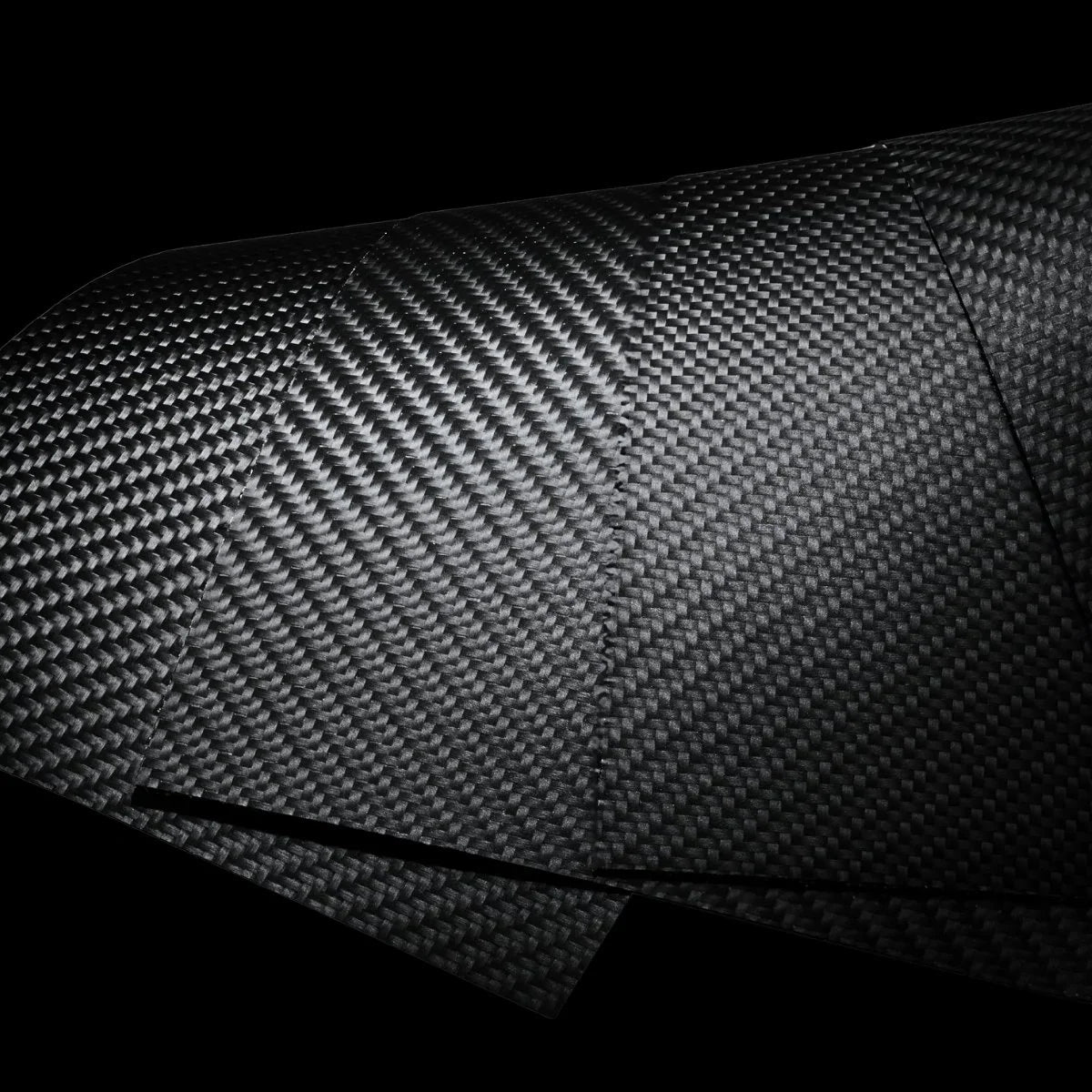
Most products sold as "carbon fiber" contain no carbon fiber. The pattern is printed on vinyl, embossed into plastic, or coated onto a leather split, and the word is there to justify the price. Real carbon fiber is a specific material, a textile of carbon filaments set in a matrix, and it has physical properties that a print cannot imitate: it conducts electricity, it has depth under angled light, it shows its layers at a cut edge, and it is either stiff or, in one engineered form, springs back without a plastic crackle. This guide explains what real carbon fiber is, what forged carbon is and whether it counts, the five kinds of fake, seven tests you can do at home or in a shop, and what to ask a wallet brand before you believe the word on the product page. For the difference between rigid and flexible carbon once you know it is real, see flexible vs traditional carbon fiber wallets.

The short answer
Real carbon fiber is woven or moulded from actual carbon filaments and behaves like a composite: light, stiff or spring-flexible, conductive, with visible layers at any cut edge and a weave that has depth when you tilt it. Fake carbon fiber is a picture of that weave on vinyl, plastic, resin or coated leather, and it behaves like whatever it is printed on. The fastest tests are a tilt under a lamp, a look at an edge, and a bend. The most conclusive test is a multimeter on an exposed edge, because carbon conducts and nothing used to fake it does. If a product page will not name the carbon material and its maker, assume it is a print.
What real carbon fiber actually is
Carbon fiber starts as a polymer thread, usually polyacrylonitrile (PAN), that is stretched and heated in stages to around 1,000 to 2,000 degrees Celsius until almost everything except carbon has been driven off. What remains is a filament five to seven thousandths of a millimetre across, far thinner than a hair, with its carbon atoms aligned along its length. That alignment is where the strength comes from: a single filament has a tensile strength several times that of steel at a fraction of the density. Thousands of filaments are bundled into a tow (1K, 3K and 12K are the common counts, meaning 1,000, 3,000 or 12,000 filaments), and tows are woven into cloth. The checkerboard most people picture is a 2x2 twill of 3K tows; plain weave and unidirectional cloth exist too.
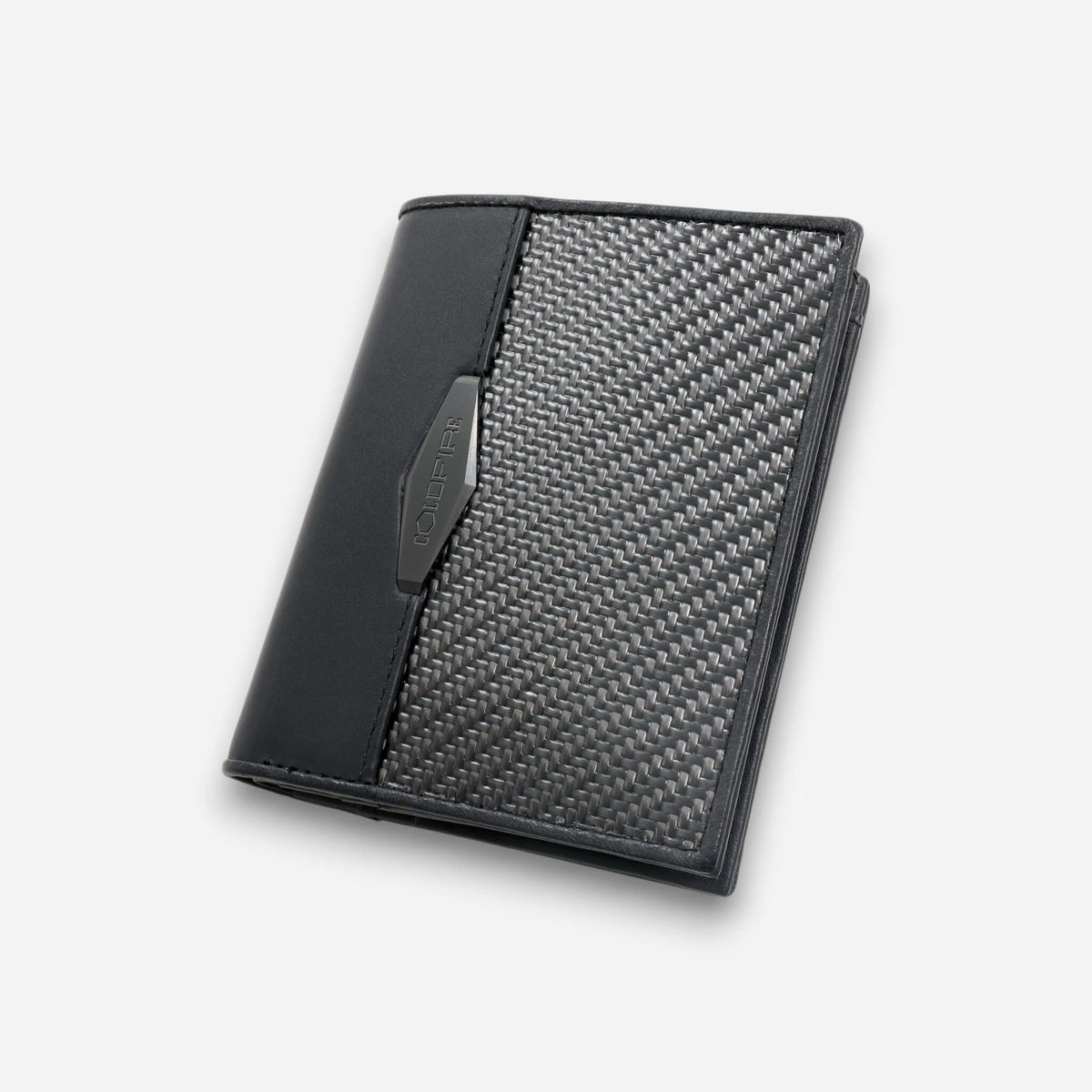
Cloth on its own is just fabric. It becomes carbon fiber as a material when the cloth is set in a matrix. In the familiar rigid form, that matrix is epoxy resin: layers of cloth are saturated, stacked and cured under heat and pressure into a stiff, glass-smooth panel. The gloss everyone associates with carbon is the polished resin, not the fibre. In the flexible form, which is what our Flex and Strike wallets are built from, the same woven carbon is set in a matrix engineered to bend and recover rather than to lock rigid, and the surface is a thin laminate rather than a block of resin. Carbitex, the American company that developed this, calls theirs CX6 (OmniFlex); the card that ships in the box with our Carbitex wallets puts it in their words: "real carbon fiber, harnessing carbon fiber's extreme performance in a flexible form". We compared the two forms on tensile strength and density against titanium, aluminium, steel and leather in what is the strongest wallet material.
Three properties follow from all this, and they are the basis of every test below. Carbon fiber is electrically conductive, because it is carbon. It is light, around 1.5 to 1.6 grams per cubic centimetre as a cured composite, roughly a fifth of steel. And it is a stack of real layers, so a cut edge shows them, like the edge of plywood.
What is forged carbon fiber, and is it real?
Forged carbon is real carbon fiber in a different form. Instead of weaving continuous tows into cloth, the tows are chopped into short lengths, typically around 25 mm, mixed with resin as a paste, and compression-moulded in a heated die. The fibres end up pointing in every direction, which gives the marbled, random surface that has become fashionable in watches, rings, car trim and rigid wallets. The technique was developed around 2010 by Lamborghini with Callaway Golf, who wanted carbon parts in complex shapes that could be pressed in minutes rather than laid up by hand, and Lamborghini used it in the Sesto Elemento.
Whether it is "as good as" woven carbon depends on the job. Because the fibres are short and randomly oriented, forged carbon is roughly equally strong in every direction, which woven cloth is not, but its tensile strength along any one direction is well below that of a continuous-fibre laminate, where every filament runs unbroken from edge to edge. It is excellent for complex shapes and for parts loaded from several directions. It is rigid, so a wallet described as forged carbon is usually a plate or a case rather than a bifold. And because the look is easy to imitate with a printed marble pattern under clear plastic, or with chopped glass fibre dyed black in resin, forged carbon is faked as often as woven carbon is. The tests below apply to it in the same way.
| Woven carbon (rigid) | Flexible carbon (Carbitex CX6) | Forged carbon | |
|---|---|---|---|
| Fibre | Continuous tows, woven | Continuous tows, woven | Chopped tows, random |
| Matrix | Epoxy, cured hard | Flexible engineered matrix, thin laminate surface | Epoxy, compression moulded |
| Surface | Glossy resin, weave visible under it | Matte or glossy laminate, weave can be felt | Marbled, random |
| Behaviour | Stiff | Bends and springs back | Stiff |
| Strength | Highest along the fibres | Same fibres, keeps tensile strength, folds | Lower in any one direction, even in all |
| In a wallet | Plates, hard cases, money clips | Bifolds, cardholders, sleeves | Plates and cases |
| Conducts electricity | Yes | Yes | Yes |
The five kinds of fake carbon fiber
- Carbon fiber vinyl. A PVC film printed and embossed with a weave pattern, sold by the roll for wrapping car trim and laptops, and used on cheap wallets, phone cases and watch straps. "3D", "4D" and "5D" are grades of how convincing the emboss and gloss are. It has no fibre in it at all, it peels at edges, and it is the most common fake by volume.
- Carbon fiber leather, or "carbon leather". A leather split or a PU synthetic with a weave pattern pressed into a coating. Often sold at a premium as if it were a hybrid material. It is embossed leather, or embossed plastic, and it contains no carbon.
- Carbon print on plastic. Injection-moulded ABS or polycarbonate with the pattern printed or hydro-dipped on, then clear-coated. Phone cases, sunglasses arms, cheap money clips. Glossy and perfectly regular.
- Glass fibre in black resin. Real composite, wrong fibre. Fibreglass cloth dyed or pigmented black, laid up in epoxy, looks close to woven carbon and is heavier, less stiff and non-conductive. Also used to fake forged carbon by chopping it.
- Carbon veneer over something else. A single real carbon layer, sometimes only a few tenths of a millimetre, glued over plastic or aluminium. Technically "real carbon fiber" on the surface; structurally it is the material underneath. Common in rigid wallets and car interiors. Not a fake exactly, but not what the price implies.
Seven tests: how to tell real carbon fiber from fake
1. Tilt it under a single light
Real woven carbon has depth. The tows are round bundles, so as you tilt the piece under a lamp the light moves across each bundle and the checkerboard appears to shift and shimmer, with some squares bright and their neighbours dark, swapping as the angle changes. A print has no depth; the pattern stays flat and the gloss moves across it as one sheet. Vinyl and prints also repeat perfectly, because they come off a roller, while a real weave has small irregularities every few centimetres.
2. Look at an edge or a cut
Find any edge, hole, cut-out or screw countersink. Real carbon laminate shows thin layers in cross-section, dark lines stacked like plywood, and the weave runs into the edge. Vinyl shows a film with a lifting corner. A print on plastic shows plain plastic the moment the surface stops. Forged carbon shows chopped fibre throughout the cross-section, not just on the face. On a COLDFIRE wallet the carbon edge is sealed inside a French welt of kangaroo leather, so look instead at the surface of the weave itself: under the laminate the individual fibre bundles are visible and can be felt with a fingertip, which is not possible when carbon is cast in a block of epoxy.
3. Bend it
Rigid real carbon does not bend by hand in any thickness used for a product; if a "carbon fiber" plate flexes easily, it is plastic. Flexible real carbon (Carbitex) bends like a stiff leather and springs straight back with no crackle and no white stress mark at the fold. Fake flexible carbon is textured TPU or vinyl-wrapped plastic, and it either creases, crackles, or stays bent.
4. Tap it and weigh it
A cured carbon panel gives a dry, hard, high tap, more like ceramic than plastic. Plastic sounds dull, fibreglass sits in between and is noticeably heavier for the same size. If you have a kitchen scale and a competitor's spec sheet, weigh the product: a carbon plate wallet that weighs what an aluminium one does is probably aluminium with a veneer.
5. Check conductivity
This is the one test a fake cannot pass. Carbon fiber conducts electricity; vinyl, PU, plastic, epoxy alone and glass fibre do not. Set a multimeter to continuity or resistance and touch both probes to bare carbon, an exposed edge or a sanded spot in a hidden area. Real carbon reads a low resistance, which depends on the distance between the probes, and a continuity buzzer usually sounds. A print reads open circuit. You need bare fibre for this, so it works on cut edges and on rigid parts with countersinks, and it does not work through a resin or laminate surface, which insulates.
6. Scratch a hidden spot
On "carbon leather" and printed plastic, a light scratch with a fingernail or a key on an inside edge reveals plain material under the printed skin. Real carbon has no skin to scratch off; the weave goes all the way down. Do this where it will not show, and do not do it to someone else's product.
7. Read the product page
Real carbon fiber is expensive to make, and companies that pay for it say so. Look for the material named with its maker: Carbitex CX6, Toray T700, Hexcel, a named prepreg. Look for the weave specified (3K 2x2 twill) or the process described. Look for a price that reflects it. "Carbon fiber texture", "carbon fiber style", "carbon look", "carbon pattern" and "carbon fiber leather" are all phrases that mean the opposite of what they imply, and a listing that uses the words "carbon fiber" without ever saying what carbon fiber or who made it is telling you the answer.

What a "carbon fiber wallet" usually means
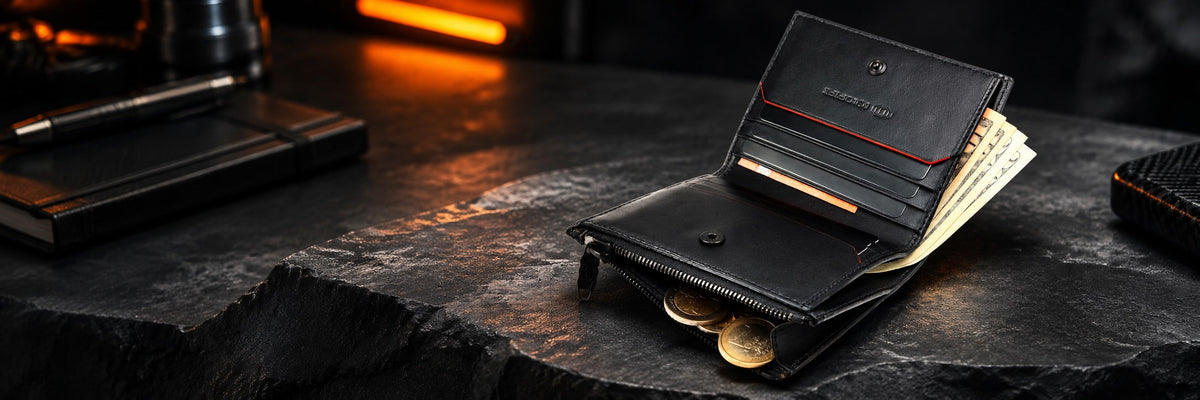
Search the phrase and the results sort into four groups. At the bottom of the price range are vinyl and "carbon leather" bifolds with no carbon in them; the tests above fail them in seconds. Next are rigid plate wallets, where the "carbon" version is usually a real carbon veneer or a thin carbon laminate over the same construction as the aluminium model, and sometimes forged carbon; real, rigid, and worth checking the weight against the metal version. Then there are cardholders and money clips machined or laid up from solid rigid carbon laminate, real and stiff. And there is a smaller group of folding wallets built on flexible carbon, including the COLDFIRE Flex and Strike series, where the flexible matrix is what lets a carbon wallet fold at all. The buying consequences of rigid versus flexible are in Best Ridge Wallet Alternatives; the lifespan consequences are in how long does a wallet last.
A note on gloss, because it is where buyers get misled in both directions. Glossy does not mean real: the easiest fake to make is a print under clear plastic, which is glossy by nature. Matte does not mean fake either: flexible carbon has a thin laminate surface that the maker can specify matte or glossy, and COLDFIRE chose matte partly because the weave can be felt through it and partly because high shine on a wallet now reads as a wrap. Judge by the tests, not the finish.
How to verify a COLDFIRE wallet
We would rather you check than trust us, so here is how. Our Flex and Strike wallets ship with four cards in the box: one from Carbitex describing CX6, one from Packer Leather on the kangaroo hide, one on RFID Data Armor and one on the finishing, with the Dyneema lining, military-grade AMANN Strongbond thread and the titanium plate. The Carbitex and Packer cards are the suppliers' own, not ours. On the wallet itself, tilt the shell under a lamp and watch the weave shift; run a fingertip across it and feel the fibre bundles under the matte laminate; fold it and feel it spring back with no crackle. The full bill of materials, with every maker named, is on the Engineering and Quality page, and the reasoning behind naming every material is in COLDFIRE Paper No. 001.
- Carbon fiber (Flex and Strike)
- Carbitex OmniFlex (CX6) flexible carbon fiber, Carbitex, Inc., Kennewick, Washington. Woven continuous carbon in a flexible matrix, matte laminate surface.
- Verified by
- Carbitex card in the box; tilt, touch and flex tests above; material named on the product page.
- Not used
- Vinyl, carbon print, "carbon leather", carbon veneer, forged carbon.
The wallets built on real flexible carbon are in the GT Rebel collection, and every material is named with its maker on the Engineering and Quality page.
Real vs fake carbon fiber, answered
How can you tell if carbon fiber is real?
Tilt it under one light: real weave has depth and shimmers square by square, a print stays flat. Look at an edge: real carbon shows stacked layers, a fake shows film or plain plastic. Bend it: rigid carbon does not flex by hand, flexible Carbitex springs back without crackle, plastic creases. For certainty, a multimeter on bare carbon shows continuity; nothing used to fake carbon conducts.
Is forged carbon fiber real carbon fiber?
Yes. It is chopped carbon tow compression-moulded in resin rather than woven cloth, developed around 2010 by Lamborghini and Callaway Golf. It is strong in all directions but weaker along any one direction than a continuous woven laminate, rigid, and often imitated with printed marble patterns or chopped glass fibre.
Is "carbon fiber leather" real carbon fiber?
No. It is leather split or PU with a weave pattern embossed into a coating. It contains no carbon and has none of its properties; a scratch on a hidden area shows plain material under the pattern.
Does real carbon fiber conduct electricity?
Yes, because the filaments are carbon. On bare fibre, an exposed edge or a sanded spot, a multimeter reads low resistance and a continuity buzzer sounds. Vinyl, plastic, epoxy and glass fibre read open circuit. The resin or laminate surface insulates, so the probes have to reach the fibre.
Is matte carbon fiber fake?
No. Rigid carbon is glossy because its epoxy surface is polished; flexible carbon has a thin laminate surface that can be matte or glossy. Gloss is also the easiest thing to fake, since a print under clear plastic is glossy by nature. Judge by depth, edge, flex and conductivity, not finish.
Can real carbon fiber be flexible?
Yes. Carbitex engineers woven continuous carbon fiber in a matrix that bends and recovers instead of curing rigid, keeping the fibre's tensile strength in a form that folds. It is what lets a carbon fiber wallet fold, and it is the material in our Flex and Strike wallets. Our Prism wallets are real carbon fiber too, but not from Carbitex.
Written by Todor Georgiev, founder of COLDFIRE and a leather goods manufacturer in Plovdiv since 2000. Carbon fiber manufacturing figures are from standard composites references; forged carbon history from Lamborghini and Callaway's own accounts; Carbitex CX6 description from Carbitex's supplier card and published material.

Share:
Minimalist Wallets Explained: The 5 Formats, How Many Cards, and the Best of 2026
Front Pocket Wallets: Why Men Are Switching, What Actually Fits, and the Best of 2026