
A buyer's guide to the difference between rigid and flexible carbon fiber, and why it decides how a wallet performs in real carry.

Carbon fiber has become the headline material in premium wallets. But "carbon fiber" on a product page can mean four or five very different things, and only one of them makes a wallet you will actually want to carry. This guide separates the real material from the look-alikes, explains the difference between rigid and flexible carbon fiber, and gives you a simple test to tell genuine carbon from a print.
What most people call carbon fiber
Most "carbon fiber" wallets on the market contain no structural carbon at all. The pattern is a finish, not a material. The common impostors are:
- Carbon print or "carbon leather". A carbon-weave pattern printed on PU or film over a cheap base, sometimes a coated leather offcut. Despite the name there is no carbon fiber in it.
- Hydro-dip or vinyl wrap. A carbon-pattern film wrapped over plastic or aluminium, the same technique used on car trim. It lifts at the edges and has no structural role.
- Forged-carbon look. Chopped fiber and resin moulded for a marbled appearance. It can contain real fiber, but as a rigid casting it behaves like plastic, not like a textile.
All three copy the appearance of carbon at a low price, with none of the strength, weight or durability that makes the real material worth buying.
What real carbon fiber actually is
Genuine carbon fiber is a woven textile of carbon filaments, set in a resin matrix to form a composite. In its honest forms it comes in two types:
- Rigid woven laminate. Layers of carbon cloth (often prepreg, pre-impregnated with resin) cured into a stiff panel. Strong and light, but it does not bend.
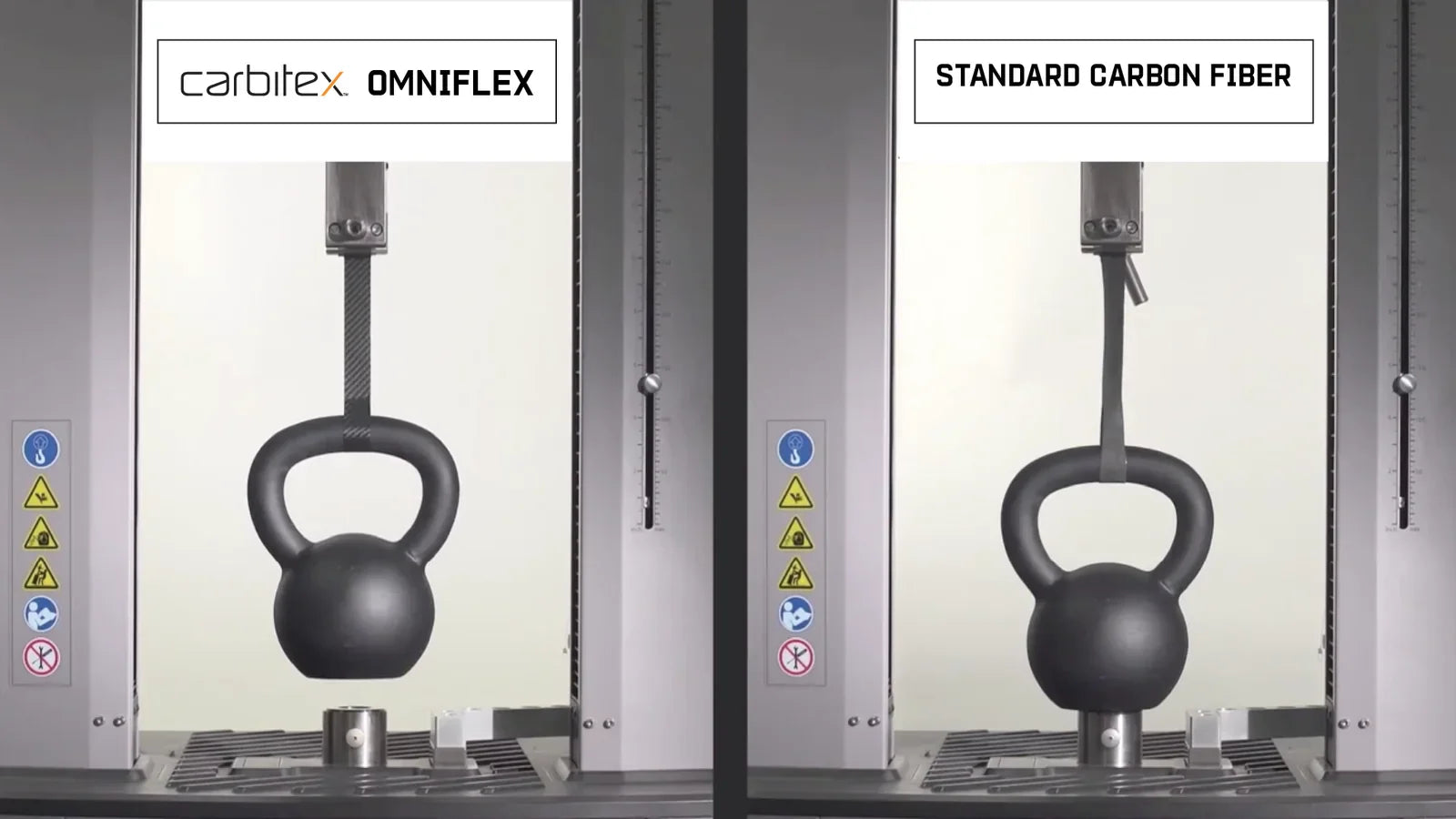
- Flexible carbon composite. The same carbon filaments engineered in a matrix that folds and springs back without cracking, such as Carbitex OmniFlex. It keeps carbon fiber's tensile strength in a form that bends.
This is the real choice that decides how a wallet behaves: rigid or flexible.
Why most carbon fiber wallets feel hard
If you have handled a carbon fiber wallet and found it stiff, you met a rigid build. Most carbon wallets are made from a rigid plate, a metal chassis, or a sandwich construction that bolts plates together. They protect cards well, which is why the format suits money clips and hard card cases. But a rigid plate cannot fold into a true bifold, and it never conforms to your pocket. In a back pocket it stays a hard plate, and over time its edges press into everything around it. For two or three cards it works. For a wallet you sit on every day, it fights you.
What makes flexible carbon fiber different
Flexible carbon fiber was developed for performance applications, where a part has to be both strong and able to move. Genuine Carbitex OmniFlex keeps carbon fiber's high tensile strength and no-stretch behaviour, but bends naturally and returns to shape thousands of times without fatigue. In a wallet that combination does something neither leather nor rigid carbon can do alone. It holds structure under a full load of cards, so it resists the stretch and swell that turn a leather bifold into a brick within a year, yet it folds like leather and disappears in a front or back pocket. You get the protection of carbon with the feel of fine leather, in a profile measured in millimetres.

Flexible vs rigid carbon fiber: side by side
| Feature | Flexible carbon fiber | Rigid carbon fiber |
|---|---|---|
| Folds into a bifold | Yes | No |
| Pocket comfort | Conforms to your body | Stays a hard plate |
| Shape retention | Permanent | Permanent |
| Everyday carry | Ideal | Better for hard cases and clips |
| Feel | Refined, leather-like | Technical, tool-like |
If you carry two or three cards and want a hard shell, rigid carbon is reasonable. If you want a wallet that carries cards and bills, lives in your pocket, and still looks slim after a year, flexible carbon fiber is the better tool.
How to tell real carbon fiber from fake
You do not need a lab. You need light and a few seconds.
- Tilt it under angled light. Real woven carbon has depth, so the sheen shifts as you move it. A printed pattern stays flat and repeats too perfectly.
- Look at the edges. Genuine carbon laminate shows fine layered lines in the cross section, like the edge of plywood. A wrap or print shows a seam or a lifting film.
- Bend it. Real flexible carbon springs back with no plastic crackle. Fake "flexible carbon" is textured TPU or plastic, and it feels like that the moment you flex it.
- Scratch test for "carbon leather". A light scratch on a hidden area of a coated product reveals plain material under the printed film. Real carbon has no skin to scratch off.
- Weigh and tap it. Carbon composite is light and rigid with a dry, hard tap. Resin-and-plastic imitations feel heavier or sound hollow.
- Check the price and the name. Genuine flexible carbon is costly to make. If a listing does not name the actual carbon material (ours is Carbitex OmniFlex), assume it is a print.
How COLDFIRE builds flexible carbon fiber wallets
Every wallet in the COLDFIRE GT Rebel collection is built on genuine Carbitex OmniFlex (CX6) flexible carbon fiber, paired with K-Leather kangaroo hide and Grade 5 titanium hardware, with RFID Data Armor shielding integrated into the structure of every model.
The lineup splits into two architectures so the carry suits you, not the other way around. The Strike series is the full-size horizontal bifold for back pocket or jacket, carrying six to eight cards plus bills. The Flex series is the compact vertical bifold for the front pocket, slimmed to three or four cards at five to five and a half millimetres. Both share the same flexible carbon fiber construction and the same five-year guarantee. For the leather side of the story, see our deeper comparison of leather wallets vs carbon fiber wallets.

A French welt leather edge and a custom COLDFIRE zip pull on a finished wallet.
Flexible carbon fiber wallet FAQ
Is flexible carbon fiber as strong as rigid carbon fiber?
It uses the same carbon fibers and keeps the same high tensile strength. The difference is the matrix around them, which is engineered to bend instead of holding a fixed shape. For a wallet, flexible is the more useful form of that strength.
Does flexible carbon fiber wear out from folding?
Genuine flexible carbon such as Carbitex OmniFlex is designed to flex repeatedly without fatigue or cracking. That endurance is exactly what separates it from a printed or plastic imitation, which fails quickly at the fold.
Is "carbon leather" real carbon fiber?
No. "Carbon leather" or "carbon fiber leather" is usually a synthetic such as PU or PVC embossed with a carbon-style pattern, sometimes over a coated leather base. It copies the look but has none of the strength, weight or durability of woven carbon fiber.
Which COLDFIRE wallet should I choose?
If you carry a full load and want it to disappear in a jacket or back pocket, choose Strike. If you carry less and want the thinnest credible bifold that still holds bills, choose Flex.
COLDFIRE designs and builds flexible carbon fiber wallets by hand in Plovdiv, Bulgaria, using genuine Carbitex OmniFlex carbon fiber, kangaroo leather and titanium hardware. Explore the full range in the GT Rebel collection.


Share:
Best Slim Wallets for Men 2026: Real Numbers, Honest Picks
Carbon Fiber Wallets Compared: COLDFIRE, Common Fibers, PITAKA and The Ridge