
An honest look at four very different wallets that all get filed under "carbon fiber", and how to choose between them.
Search for a carbon fiber wallet and you will meet products that have almost nothing in common except the word. One is a rigid metal-and-carbon plate. One clips to the back of your phone. One is a real flexible carbon bifold. They solve different problems, so the right answer depends entirely on how you carry. Below is a fair comparison of four of the most recognised names, what each is actually made of, and who each one suits.

At a glance
| Brand | Core material | Design | RFID | Made in | Best for |
|---|---|---|---|---|---|
| COLDFIRE | Carbitex CX6 flexible carbon fiber + kangaroo leather + Grade 5 titanium | Full-size and front-pocket bifolds | Built in (RFID Data Armor) | Bulgaria (EU) | A real folding wallet in flexible carbon and leather |
| Common Fibers | Flexible carbon fiber (hybrid weaves), ripstop or leather interior | Minimalist, bifold, money clip | Yes (on RFID models) | USA | Real flexible carbon, made in the USA |
| PITAKA | Cadmyra aramid fiber, carbon layer for cards | MagSafe modular card holder | Yes | China | Phone-attached MagSafe carry |
| The Ridge | Aluminum, titanium or carbon fiber plates | Rigid plate with elastic band | Yes | USA brand | Ultra-minimal metal card holder |
The Ridge: the rigid minimalist
The Ridge is the wallet that made the category famous. It is two rigid plates, in aluminum, titanium or carbon fiber, screwed together and bound by an elastic band, with a money clip or cash strap on the back. It holds up to a dozen cards, blocks RFID and is close to indestructible.
What it is not is a folding wallet. It is a hard plate by design, so it never conforms to your pocket and is built for people who want the absolute minimum: a few cards and a clip. If that is you, it is excellent. If you want something that folds and carries bills like a traditional wallet, it is the wrong tool.
PITAKA: the phone-first option
PITAKA comes at the problem from the phone. Its signature wallets are MagSafe modules in Cadmyra, a flexible aramid fiber, that snap onto the back of an iPhone, with a thin carbon layer to protect cards from the magnets. They are light (around 38g) and beautifully made, but they are minimalist by nature, typically two or three cards, and the experience is built around attaching to a device rather than carrying a standalone wallet.
Note that the headline material here is aramid fiber, not carbon fiber. It is a genuinely high-performance textile, just a different one. If your carry revolves around your phone, PITAKA is the cleanest answer on the market.
Common Fibers: real flexible carbon, made in the USA
Common Fibers is the closest competitor to COLDFIRE in material philosophy, and credit where it is due: they make real flexible carbon fiber wallets in the USA, including their own carbon fiber hinge, and they offer minimalist, bifold and leather-lined options. If you want genuine flexible carbon from a US maker, they are a serious choice and have earned their reputation.
The differences are in the details: their exterior weaves often blend carbon with fiberglass or other fibers for colour and effect, and the interiors are typically ripstop nylon. It is a more technical, sport-styled take on the material.
COLDFIRE: flexible carbon and leather, built in the EU

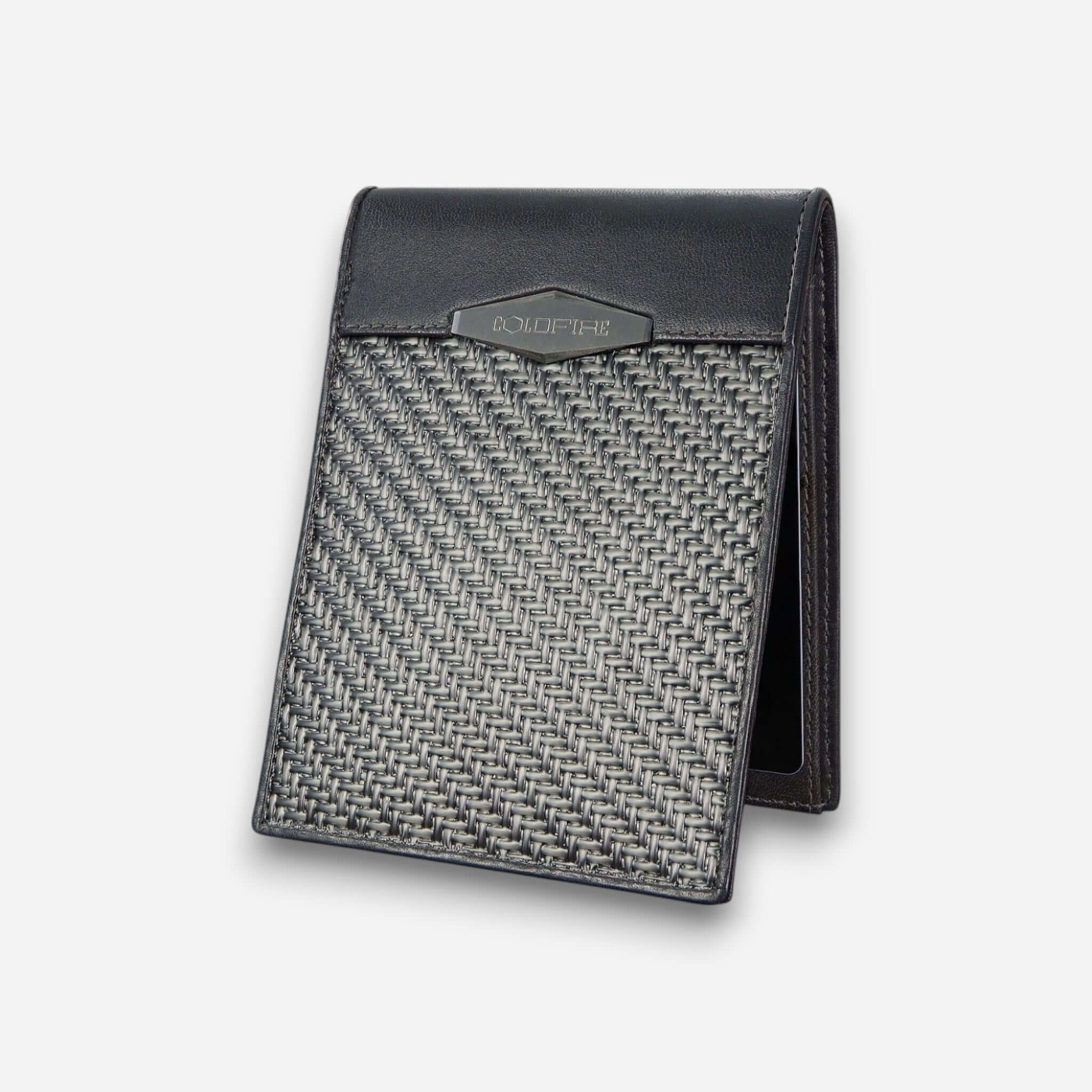
COLDFIRE sits in the same flexible-carbon world but makes a different choice about what a premium wallet should feel like. Every wallet pairs genuine Carbitex OmniFlex (CX6) flexible carbon fiber with K-Leather, full kangaroo leather (the strongest natural leather by weight), and Grade 5 titanium hardware, with RFID Data Armor shielding built into the structure. The carbon keeps the wallet permanently slim and structured; the kangaroo leather gives it the warmth and hand-feel of a fine leather good.
The format is also different. Rather than a card-holder-first approach, COLDFIRE builds true bifolds in two architectures: the Strike series is a full-size horizontal bifold for back pocket or jacket, and the Flex series is a compact vertical bifold for the front pocket. Everything is handmade in Plovdiv, Bulgaria, inside the EU, and backed by a five-year guarantee. For EU buyers in particular, that means no customs surprises and fast shipping.

COLDFIRE's French welt edge: kangaroo leather rolled over the carbon shell, a hand finish the nylon-lined competitors do not offer.
Which one is right for you?
- You want the absolute minimum, a few cards and a clip: The Ridge.
- Your carry is built around your phone: PITAKA.
- You want real flexible carbon from a US maker, sport-styled: Common Fibers.
- You want a true bifold that combines flexible carbon with real leather, made in the EU: COLDFIRE.
There is no single best carbon fiber wallet, only the best one for how you carry. The useful question is not which brand is "the best", but whether you want a rigid plate, a phone module, or a folding wallet, and whether you want your carbon paired with nylon or with leather.
How to make sure the carbon is real
Whichever brand you choose, confirm the carbon is genuine. Real flexible carbon springs back from a fold with no plastic crackle, has depth that shifts under angled light, and is named explicitly (Carbitex, for example) rather than described only as a "carbon look". For the full method, see our guide to flexible carbon fiber vs traditional carbon fiber wallets, and for the leather side of the decision, leather wallets vs carbon fiber wallets.
FAQ
Is carbon fiber or aramid fiber better in a wallet?
Both are strong, light, high-performance textiles. Carbon fiber is stiffer and more structural, which suits a wallet that needs to hold its shape; aramid (as in PITAKA's Cadmyra) is prized for abrasion and scratch resistance. The better choice depends on whether you want a structural bifold or a slim phone module.
Which carbon fiber wallets are real bifolds?
The Ridge and most PITAKA wallets are card holders, not folding bifolds. Common Fibers and COLDFIRE both make true flexible carbon bifolds; COLDFIRE pairs the carbon with kangaroo leather and offers both full-size and front-pocket formats.
Where is each brand made?
The Ridge and Common Fibers are US brands, PITAKA is made in China, and COLDFIRE is handmade in Plovdiv, Bulgaria, inside the EU.
Which is best for EU buyers?
For buyers in Europe, COLDFIRE ships from within the EU, which avoids the import duties and longer transit times that can apply to US and China-based brands.
COLDFIRE designs and builds flexible carbon fiber wallets by hand in Plovdiv, Bulgaria, using genuine Carbitex OmniFlex carbon fiber, kangaroo leather and titanium hardware. Explore the range in the GT Rebel collection. Comparisons reflect publicly available information about each brand at the time of writing.


Share:
Flexible Carbon Fiber vs Traditional Carbon Fiber Wallets
Metal & Aluminum Wallets vs Flexible Carbon Fiber: Which Slim Wallet Wins?