
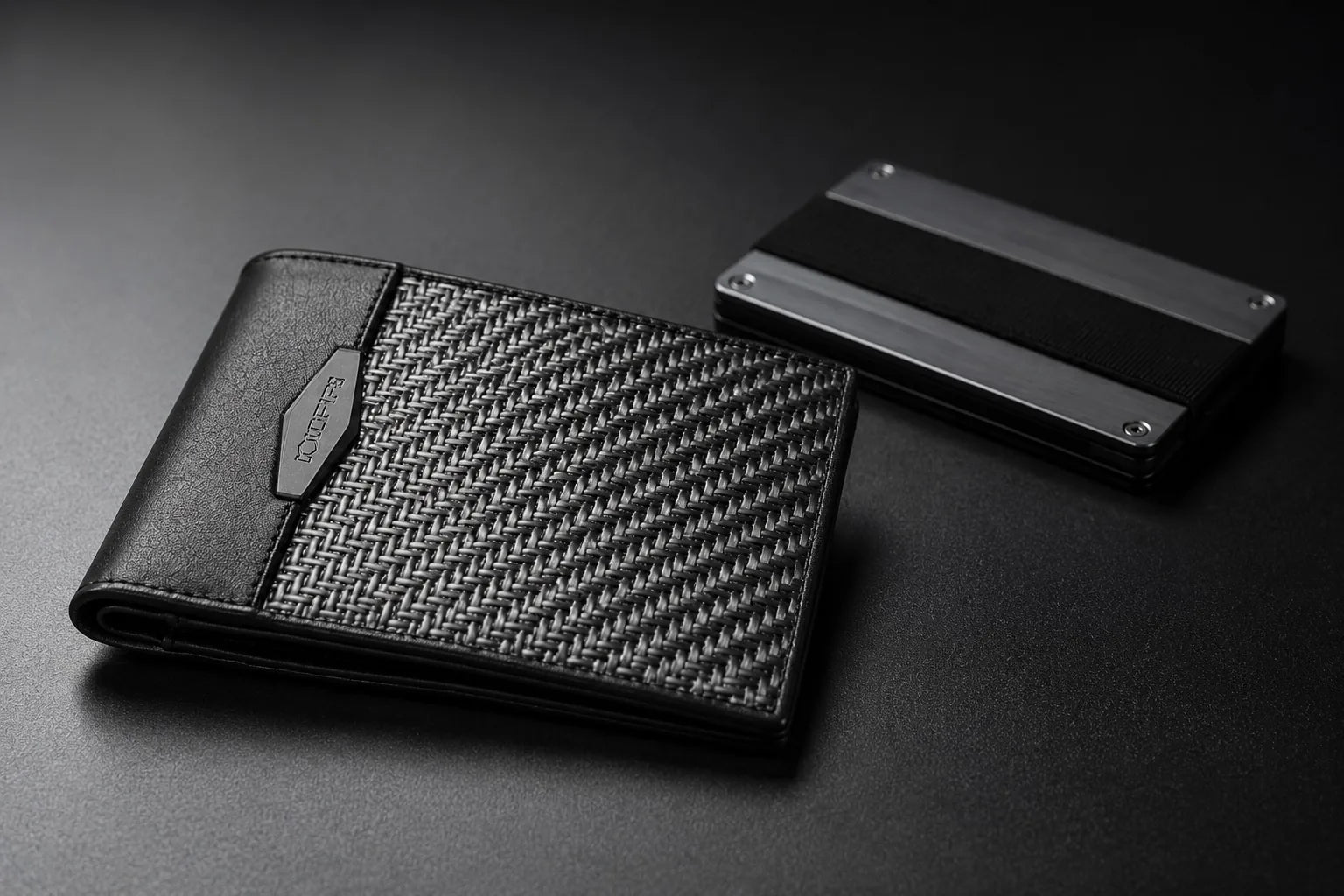
The slim wallet world has split into two camps. Both promise to fix your fat leather brick. They could not feel more different in your pocket.

A decade ago, going slim meant one thing: a metal card case. Two machined plates, an elastic band, a satisfying click. It looked like a tool, and that was the appeal. Then a second option arrived: flexible carbon fiber, the same family of material as the metal camp's "carbon" plates, except engineered to bend instead of staying stiff.
They sound similar on a spec sheet. They are nothing alike to live with. Here is the honest comparison, including the parts the metal camp would rather you discovered after the warranty runs out.
First, credit where it is due: metal wallets are good at one job
Aluminum and titanium card wallets, the Ridge and Ekster and Secrid school, are genuinely excellent at minimal carry. A typical build is two plates of 6061-T6 aluminum or Grade 5 titanium, held by an elastic band, with a money clip or a clever pop-up lever that fans your cards out on demand. They are slim, nearly indestructible, block RFID, and that machined look has real appeal.

If you carry three cards and a folded note and you want the most bulletproof, minimal object possible, a metal wallet is a reasonable choice. We are not going to pretend otherwise.
Now the part nobody photographs for the ad
The trouble with metal starts the moment you actually live with it. None of this is our opinion alone. Some of it comes straight from the metal brands' own blogs.
It does not bend, and you do. A metal wallet is a rigid plate. Your body is not. Sit down with one in your back pocket and you are, in the most literal sense, sitting on a small metal brick all day. It will not mould to you, ever. Picture spending eight hours perched on a tile and you have the idea.

Sharp edges have opinions about your pockets and your phone. Metal wallets have hard, angled corners. Over time those corners wear holes in trouser pockets, and if the wallet shares a pocket with your phone, the metal can scratch the screen. Cards kept under tension between plates can pick up scuffs too.
No stretch means no mercy. Metal does not give. A typical metal wallet holds four to twelve cards and that is the ceiling. Add a business card you were handed at lunch and the elastic strains or the cards simply will not fit. A wallet that punishes you for receiving a receipt is a strange kind of premium.
Cold plate, warm hand. Aluminum and titanium take on the temperature of wherever they have been. On a winter morning that first reach into your pocket is a brisk surprise.
Bits that can loosen. Screws back out, elastic bands relax, pop-up levers are one more mechanism that can fail. Structure that comes from hardware is structure that can come apart.
None of these are dealbreakers for everyone. They are simply the quiet trade-offs of choosing a hard shell, and they are exactly the trade-offs flexible carbon was built to remove.
The third option: flexible carbon fiber
Most people assume carbon fiber means rigid. The plates in many metal wallets are exactly that, a stiff carbon laminate. Flexible carbon fiber is a different animal. Genuine Carbitex OmniFlex carbon fiber keeps carbon's high tensile strength and zero-stretch behaviour, but it folds and springs back thousands of times without cracking. It was engineered for advanced performance applications and elite footwear, where a part has to be both strong and able to move.

Carbitex OmniFlex flexes under a full kettlebell load where standard carbon fiber stays rigid. Image courtesy of Carbitex.
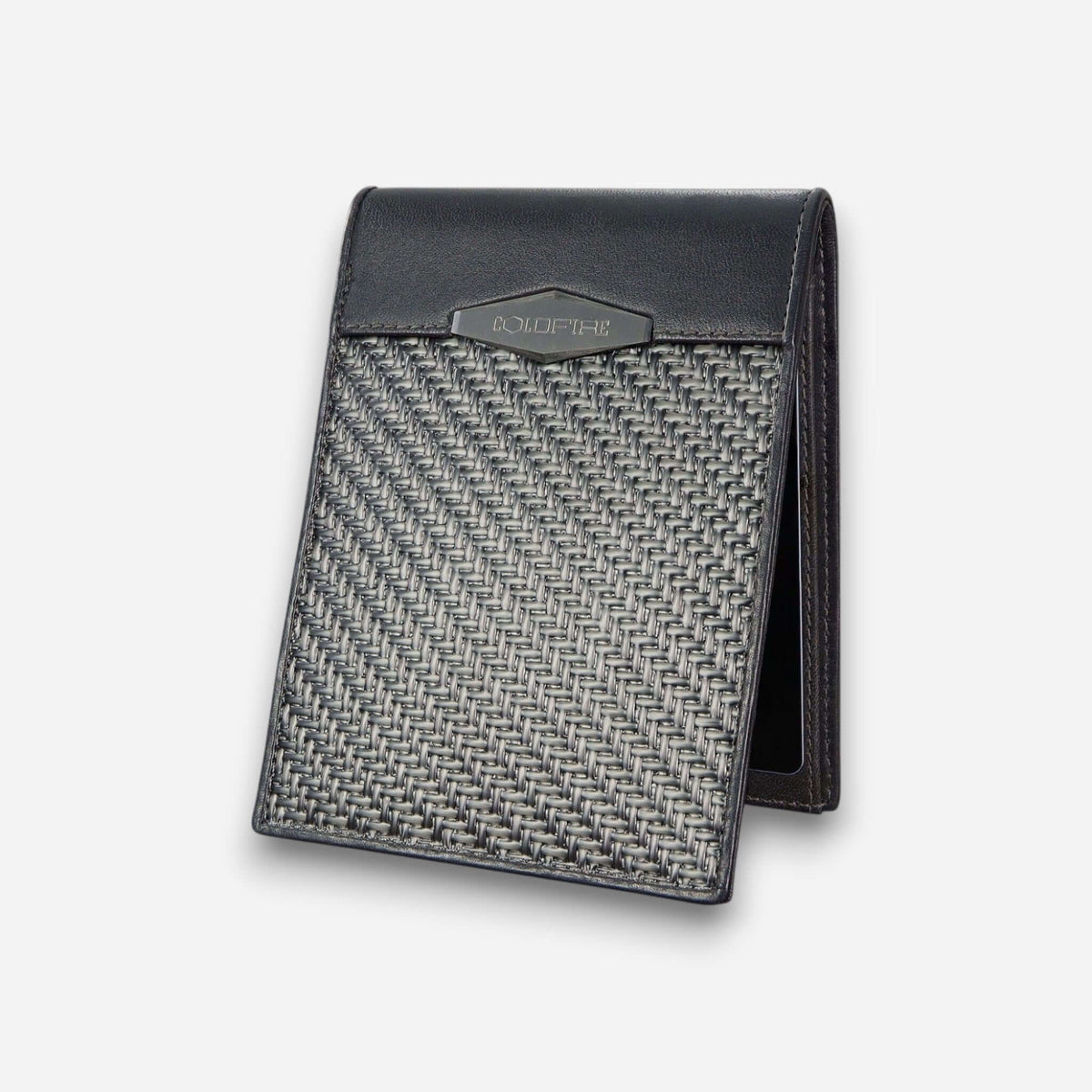
In a wallet, that combination does something neither metal nor rigid carbon can. It holds its slim profile permanently, so it never stretches or swells like leather, yet it bends with your body, conforms to your pocket, and folds into a real bifold that carries cards and bills. Pair it with leather, as a COLDFIRE GT Rebel wallet does, and you get the structure of carbon with the warmth and hand-feel of a fine leather good. No sharp edges. No cold plate. Nothing to unscrew.

The COLDFIRE Flex One: flexible carbon fiber, kangaroo leather and titanium, in a true folding bifold.
Metal vs flexible carbon, side by side
| Metal / aluminum wallet | Flexible carbon fiber wallet | |
|---|---|---|
| Comfort sitting on it | Rigid plate, stays a brick | Bends and conforms to you |
| Pocket lining | Sharp corners can wear holes | Soft edges, no abrasion |
| Near your phone | Metal can scratch the screen | Will not scratch glass |
| Capacity | Fixed, 4 to 12 cards, no stretch | Holds cards and bills, stays slim |
| Weight | Plates around 56g alone, more with a strap or leather case | Full bifold 46 to 55g; Scout One sleeve just 25g |
| Temperature | Cold to the touch in winter | Stays neutral, especially with leather |
| Form | Card case or clip | True folding bifold |
| Structure from | Screws and elastic | The material itself, nothing to loosen |
| Feel | Tool | Refined everyday object |
| RFID blocking | Usually yes | Yes, built into the structure |
So which one wins?
Honestly, it depends on what you carry.
If your entire life is three cards and a clip, and you genuinely never carry cash or a fourth card, a metal case is a perfectly good tool. It will outlive you, and you will not care that it does not bend because you are barely sitting on anything.
But if you want a wallet, an actual wallet, that holds your cards and your bills, lives in your pocket all day, takes being sat on without complaint, and still looks slim after a year, the rigid plate fights you and the flexible carbon does not. That is the whole case in one sentence: metal asks you to carry less and sit carefully; flexible carbon just gets out of the way.

For the version that pairs flexible Carbitex carbon with kangaroo leather and titanium hardware, handmade in the EU, see the GT Rebel collection. For the deeper material story, the Engineering page breaks down every component.
FAQ
Are metal wallets bad for your cards?
Not inherently, but cards held under tension between metal plates can pick up scratches, and a metal wallet sharing a pocket with keys or a phone can scratch those too. A flexible carbon and leather wallet cushions cards instead of clamping them.
Are aluminum wallets uncomfortable to sit on?
They are rigid by design, so yes, in a back pocket a metal wallet stays a hard plate all day. A flexible carbon wallet bends and conforms, which is far more comfortable for back-pocket carry.
Is flexible carbon fiber as durable as metal?
It uses the same carbon fibers as rigid carbon, with the same tensile strength, engineered to flex without fatigue. It will not dent like aluminum or scratch like a polished plate, and it holds its shape for the life of the wallet.
Does a carbon fiber wallet block RFID?
On a COLDFIRE wallet, yes. RFID Data Armor is built into the structure, blocking 13.56 MHz RFID and NFC by material, with no removable sleeve.
Is there a slim bifold with titanium hardware that isn't a metal card case?
Most "titanium wallets" are metal card cases or a titanium chassis held by an elastic band, not a folding wallet. COLDFIRE takes the opposite approach: Grade 5 Ti-6Al-4V titanium is used as hardware, the logo plate and fittings, on a true flexible carbon and leather bifold. You get aerospace-grade metal hardware and a real folding wallet that carries cards and bills, instead of a rigid plate.
What is the lightest slim wallet format?
A carbon fiber sleeve. The COLDFIRE Scout One weighs 25 grams at 5mm with RFID shielding built in, roughly half the weight of a typical aluminum wallet. Full carbon bifolds run 46 to 55g, still lighter than most metal wallets once a strap or leather case is added.
COLDFIRE builds flexible carbon fiber wallets by hand in Plovdiv, Bulgaria, using genuine Carbitex OmniFlex carbon fiber, kangaroo leather and titanium hardware. Compare the full range in the GT Rebel collection, or read Flexible vs Traditional Carbon Fiber Wallets and our four-brand Carbon Fiber Wallets Compared.


Share:
Carbon Fiber Wallets Compared: COLDFIRE, Common Fibers, PITAKA and The Ridge
What to Keep in Your Wallet: The Items, the Capacity, and the Materials That Hold Them