
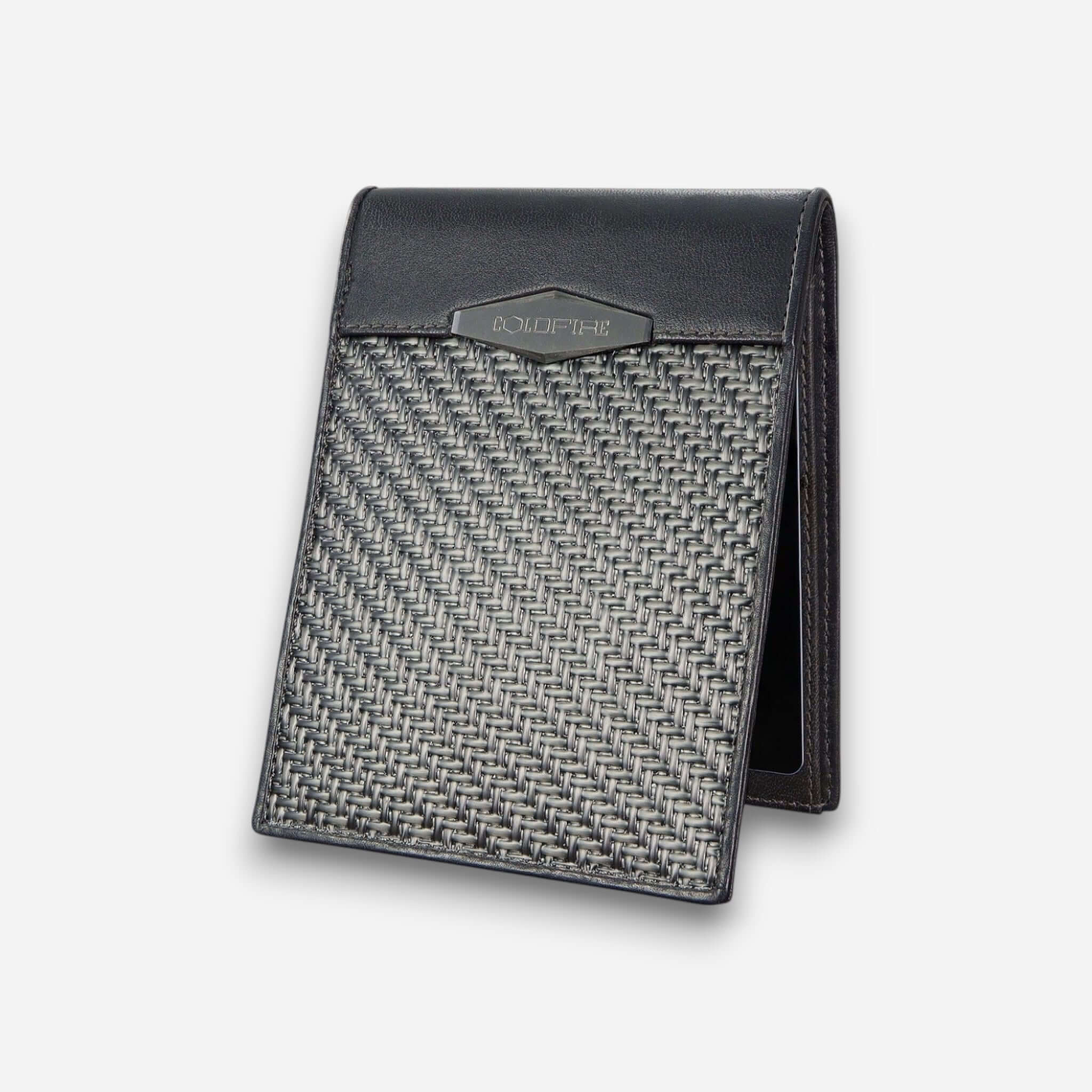
Most wallet guides are about what to carry. Cards, cash, ID — the contents. This one covers the other half of the question: what your wallet should be made of to hold those things well, for years, not months.

What should you keep in your wallet?
The short answer: less than most people carry. A wallet designed for six cards should hold six cards. Overfilling deforms the structure, stretches the stitching, and is the single most common reason wallets fail ahead of schedule — not wear, not quality, but overcapacity.
The minimum that belongs in a daily wallet:
- 2–4 payment cards — debit, credit, one backup
- National ID or driver's licence
- Health insurance card
- Emergency cash — a small folded amount for when contactless fails
What doesn't belong:
- Receipts (they add bulk, fade within weeks, and are useless after that)
- Loyalty cards used once a year (use the app)
- Old cards from closed accounts
- Your entire cash reserve
If you travel, add a separate passport holder rather than overloading your main wallet. Packing by task — daily carry vs. travel — keeps each wallet at its rated capacity.
What items are found in a wallet that holds its shape?
A wallet that holds its shape after five years of daily use starts with specific materials at the build stage. Most wallets are sold with vague language — "premium leather," "high-quality hardware," "genuine carbon" — that carries no real information. These are adjectives, not specifications.
A wallet built to last is made from named, verifiable materials:
- Genuine flexible carbon fiber — specifically Carbitex OmniFlex (CX6), manufactured by Carbitex, Inc. in Kennewick, Washington. Not a carbon print, not a wrap. The same material used in elite athletic footwear and performance applications. Validated for 10,000+ load cycles with zero permanent deformation.
- K-Leather kangaroo leather — sourced from Packer Leather, Australia, tanning since 1891 and named International Tannery of the Year in 2014. Weight for weight, kangaroo leather is the strongest and lightest natural leather available, owing to its uniquely organised fibre structure.
- Grade 5 titanium — Ti-6Al-4V — the alloy specified for jet engine components and surgical implants. Hardware that won't corrode, bend, or discolour.
- Dyneema ripstop lining — ultra-high-molecular-weight polyethylene, laser-cut. The same material used in offshore ropes and technical climbing equipment.
- AMANN Strongbond thread — OEKO-TEX Standard 100 certified bonded thread.

The complete breakdown — source, function, and test data for each material — is on the Engineering & Quality page.
What things should I keep in my wallet — and how many?
Match your carry to the wallet's stated capacity. A wallet rated for six cards is engineered for six cards: the pocket width, card retention, and overall thickness are calibrated to that number. Carrying ten cards in a six-card wallet doesn't stretch the capacity — it permanently deforms the structure.
For daily carry: 3–6 cards, folded notes, one ID. That covers everything.
For travel: swap everyday loyalty cards for travel insurance and a backup card. Keep your passport in a dedicated passport holder, separate from your main wallet. A travel wallet handles the rest: boarding pass, foreign currency, cards.

For minimalists: 2–3 cards and a small amount of folded cash covers 95% of situations. Everything else is habit you can break.
The question most wallet guides skip
Every article about what to keep in your wallet focuses on the contents. Almost none of them ask what the wallet itself is made of. After a year of daily use, a wallet built from "genuine leather" and unnamed hardware will have stretched, delaminated, or lost its shape. One built from Carbitex, Packer Leather, and Ti-6Al-4V titanium will look and function the same on day 1,825 as on day one.
At COLDFIRE, every material is listed by its maker's name. Not "carbon fiber" — Carbitex OmniFlex CX6. Not "kangaroo leather" — K-Leather from Packer Leather, Australia. Not "strong thread" — AMANN Strongbond, OEKO-TEX 100 certified. The full supply chain, the manufacturing process step by step, the test results, and the five-year structural guarantee are documented on the Engineering page. Named suppliers, not adjectives.

FAQ: What to put in your wallet
What should I put in my wallet every day?
The minimum: 2–4 payment cards, your national ID or driver's licence, health insurance card, and a small amount of folded cash for emergencies. Keep the total card count at or below your wallet's stated capacity to preserve its shape over time.
What items should I remove from my wallet?
Receipts, expired cards, loyalty cards you use less than once a month, and any card from a closed account. Each adds unnecessary thickness that works against the wallet's structure. A slim wallet isn't a style choice — it's how a well-engineered wallet is meant to be used.
What are wallets made of, and does it matter?
It matters more than the contents. Leather from Packer Leather (Australia, since 1891) outperforms unnamed hides; flexible carbon fiber from Carbitex outperforms rigid or decorative carbon; Grade 5 titanium hardware outperforms plated alloy. Named materials are verifiable. Adjectives are not.
How many cards should I keep in my wallet?
No more than the wallet's stated capacity. A 6-card wallet is engineered for 6 cards — the structure, pocket tension, and profile are all calibrated to that number. Carrying 10 cards doesn't expand the capacity; it deforms the structure permanently.
Does it matter what my wallet is made of for RFID protection?
Yes. RFID blocking built into the material — a 0.08mm copper-and-nickel conductive layer laminated into the structure during manufacturing — works independently of how many cards you carry. It blocks 13.56 MHz RFID and NFC by physics, not by a removable sleeve. The Engineering page has the technical detail.


Сподели:
Metal & Aluminum Wallets vs Flexible Carbon Fiber: Which Slim Wallet Wins?
7 Questions Every Wallet Brand Should Be Able to Answer