
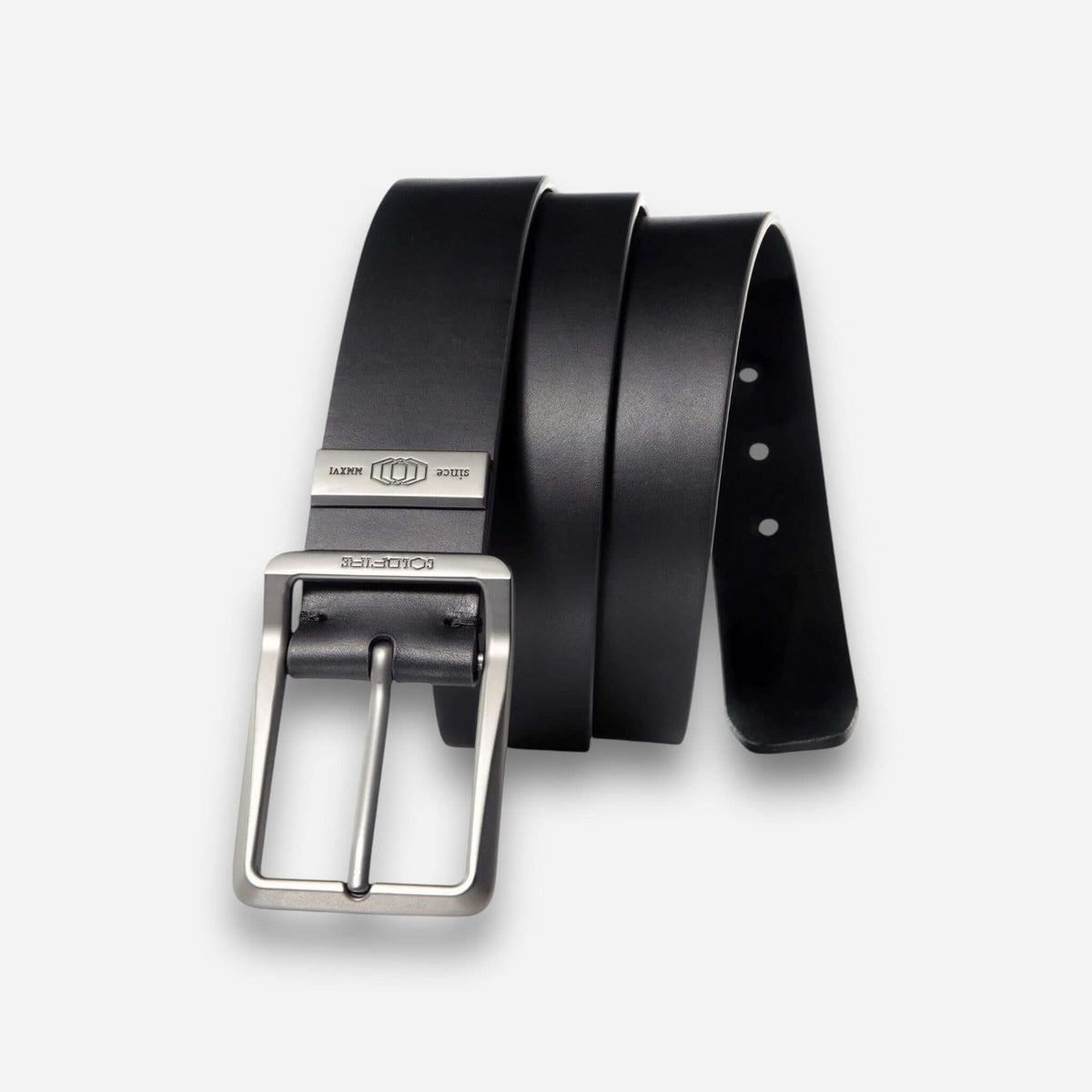
A leather belt lasts when it is cut from a single piece of full-grain hide, thick enough to hold its shape, and finished with hardware that is fastened rather than glued. Almost everything else on a product page is decoration. Most belts sold today fail in one of three predictable places, and all three are visible before you buy if you know where to look. This guide covers what actually determines a belt's lifespan, how to read the four leather grades honestly, and what to check before spending.
The three ways a leather belt fails
Belts rarely break. They degrade, in the same three places, on a schedule set by how they were made.
1. The layers separate
Most belts under about 60 euro are not one piece of leather. They are two or more thin layers bonded together, sometimes over a fabric or fibreboard core, because splitting a hide into layers yields more belts per hide. The adhesive holding those layers is what fails first. The belt starts to curl at the edges, then delaminates near the buckle where it flexes most.
A belt cut from one piece of hide has nothing to delaminate. That single decision accounts for most of the difference in lifespan across the category.
2. The fold at the buckle cracks
The leather doubles back on itself at the buckle, and that fold takes every load the belt carries. Thin leather fatigues there and cracks across the grain. Leather that is too soft stretches there instead, and the belt slowly gets longer until the hole you use is no longer the hole that fits.
3. The mechanism fails
Ratchet belts replace holes with a toothed track and a sprung clamp. They fit precisely, which is genuinely useful. They also introduce a moving part into an object that never needed one. When the clamp wears or the track deforms, the belt is finished, and it cannot be repaired the way a punched hole and a pin buckle can.
This is a trade-off rather than a fault. If you value micro-adjustment more than repairability, a ratchet is a reasonable choice. If you want the belt to outlive the decade, avoid the mechanism.
The four leather grades, stated plainly
These four terms appear on almost every belt sold, and only two of them describe leather you would want around your waist. The confusing one is deliberate: "genuine leather" sounds like a guarantee and is closer to the opposite.
| Term | What it actually is | How it ages |
|---|---|---|
| Full-grain | The complete outer layer of the hide, with the natural grain intact. Nothing sanded off. | Darkens and develops patina. Fibres stay interlocked, so it resists stretching. |
| Top-grain | The outer layer with the surface sanded and refinished to remove marks. | Softer and more uniform. Ages acceptably, but the strongest fibre layer has been removed. |
| Genuine leather | A grading term for the lower splits left after the top layers are taken. Real leather, low grade. | Does not patina. Scuffs, then cracks. Common in belts under 40 euro. |
| Bonded leather | Leather scrap shredded, mixed with adhesive and pressed onto a backing, then embossed with a fake grain. | Peels. Typically within two years of regular use. |
The practical test is not the word on the label. It is the cut edge. Full-grain shows a dense, fibrous cross-section that is the same material all the way through. Bonded leather shows a uniform layer sitting on a different-coloured backing, and the fake grain stops abruptly at the edge.
What to check before you buy
Five things, in order of how much they matter.
- Thickness. Ask for the figure in millimetres. Under about 3mm a belt will stretch and roll at the buckle under daily use. Around 3.5 to 4mm holds its structure without feeling like tack.
- One piece, or laminated. Ask directly. A brand that cuts from a single hide will say so, because it costs them more to do it.
- Hardware attachment. The buckle should be held by stitching or screws you can see, not by adhesive under a folded flap. Screws mean the buckle can be changed and the belt kept.
- Edge finish. Edges should be bevelled and burnished, sealed against moisture. A raw or painted edge is the first place a belt starts to fray, and painted edges chip.
- Stitching at the fold. Look for a tight, even stitch line at the buckle fold, ideally in a bonded thread. That fold carries the load, and a decorative single row of loose stitching is not carrying it.
Width, and what it suits
Width sets formality more than colour does.
- Under 30mm. Dress belts, worn with suits and formal trousers. Deliberately slight.
- 32 to 38mm. The versatile range. Fits the belt loops on most trousers, chinos and jeans, and reads as smart with a jacket and correct with denim.
- Over 40mm. Casual and work belts. Will not pass through the loops on many dress trousers.
If you own one belt, 38mm is the width that does the most jobs without looking wrong at any of them. Every COLDFIRE belt is 38mm, in nine sizes from 32 to 48 inches.
Sizing
Order a belt roughly two inches, or five centimetres, larger than your waist measurement. Your belt size is not your trouser size, because the belt wraps around more layers than the trousers do. If you fall between two sizes, take the larger one.
The full measuring method and the size table are on the men's belt size chart, including how to measure from an existing belt if you do not have a tape.
Care, honestly
A good leather belt needs very little, and most belt care advice asks you to do too much.
Wipe it with a dry or slightly damp cloth when it needs it. Condition it once or twice a year with a neutral leather conditioner, not more, because over-conditioning softens the fibres you are relying on for structure. Hang it or roll it loosely rather than folding it. Keep it out of direct sun and away from radiators, which dry leather out faster than wear does.
If the buckle loosens, tighten the screws. If a hole tears, a leatherworker can patch or re-punch it. Neither is a reason to replace the belt.
The COLDFIRE Titan Grip belts
Every COLDFIRE belt is cut from a single piece of Italian full-grain hide, 38mm wide and 3.8mm thick, with matte gunmetal hardware and no ratchet mechanism. Nine sizes, 32 to 48 inches. Handcrafted in Plovdiv, Bulgaria, in the same workshop as the wallets, and covered by a five-year warranty.
- Leather
- Italian full-grain hide, single piece, tannery to buckle
- Width
- 38mm
- Thickness
- 3.8mm
- Hardware
- Matte gunmetal, pin buckle, no moving parts
- Sizes
- Nine, from 32 in / 80 cm to 48 in / 120 cm. Size chart
- Made in
- Plovdiv, Bulgaria, European Union
- Warranty
- Five years
 Titan Black
 Titan Dark Oak
 Titan Cognac
 Titan Elite Pyramid
 Titan Elite Snake
The emboss on the Elite belts is pressed into the hide rather than printed onto a coating, which is why the pattern deepens with age instead of wearing off.
Know your size before you choose a colour. The belt size chart takes a minute.
The same standard applies across everything we make. Every material is named, with its maker, on the Engineering and Quality page.
Belt questions, answered
What is the difference between full-grain and genuine leather?
Full-grain is the complete outer layer of the hide with the grain intact, and it is the strongest part. Genuine leather is a grading term for the lower splits left after the better layers have been removed. Both are real leather. Only one of them holds its shape and develops a patina.
How thick should a men's leather belt be?
Around 3.5 to 4mm for a belt worn daily. Below 3mm the leather rolls and stretches at the buckle fold. Above roughly 4.5mm it becomes stiff and difficult to thread through standard belt loops. COLDFIRE belts are 3.8mm.
What belt size should I order?
Two inches, or five centimetres, larger than your measured waist. A 34 inch waist takes a 36 inch belt. If you are between sizes, take the larger one. The full table is on the men's belt size chart.
Are ratchet belts better than hole belts?
They adjust more finely, which is a real advantage. They also add a moving part that can wear out and cannot be repaired the way a punched hole can. It is a trade-off between precision of fit and long-term repairability.
How often should I condition a leather belt?
Once or twice a year with a neutral conditioner. More than that softens the fibres that give the belt its structure. Wipe it clean with a dry or slightly damp cloth as needed and keep it away from direct heat.
Can I wear a brown belt with black shoes?
In formal dress the convention is to match belt and shoe colour. In casual and smart casual it matters far less, and a dark brown belt with black shoes reads as deliberate rather than careless. The convention is worth following with a suit and worth ignoring with denim.
How can I tell a belt is good quality before buying?
Look at the cut edge for a single dense cross-section rather than layers on a backing. Check that the buckle is stitched or screwed rather than glued. Ask for the thickness in millimetres and whether the strap is cut from one piece. A brand that will not answer those three questions is telling you the answer.
Handcrafted in Plovdiv, Bulgaria. Five-year warranty on every belt. Dispatched within 24 hours.


Сподели:
Why leather wallets stretch, and how to stop it
The Most Durable Bifold Wallets for Everyday Carry: 2026 Showdown