
A front pocket wallet is a wallet you never sit on. That one change fixes most of what goes wrong with wallets: the curve that a back pocket presses into leather, the split seams, the slow slide into a brick, and the fact that a back pocket is the easiest place in the world to pick. This guide explains why men are moving their wallets forward, what actually makes a wallet work in a front pocket (it is mostly width, thickness and the direction it folds), what a vertical bifold is and why it was designed for exactly this, and which front pocket wallets are the best of 2026 by type, including two we do not make. If you are still deciding how little you want to carry, start with our minimalist wallet guide; this article assumes you have decided where the wallet is going and want the right one for the job.

The short answer
Buy a wallet under about 105 mm tall, under 90 mm wide and under 10 mm thick when loaded, in a material that does not stretch, and carry it in the front pocket opposite your phone. If you carry cards only, that is a cardholder or a card sleeve at 25 to 45 grams. If you carry cards and some cash, it is a vertical bifold, the format built for this pocket, at 45 to 60 grams. If you want a hard shell, it is a plate wallet, with the understanding that it will not fold and will carry cash under a strap. What you should not do is move your old back pocket bifold to the front. It was designed for a different pocket and it will fight you every time you sit down.
Why carry your wallet in your front pocket
Three reasons, in order of how often people give them. The first is comfort. A wallet in a back pocket is sat on for hours a day, and a thick one tilts the pelvis to one side. Back-pocket sciatica from sitting on a thick wallet is described in the medical literature, and anyone who drives or sits at a desk with a fat wallet has felt the early version of it. The second is security. A back pocket is out of your sight and out of your reach, and it is where pickpockets work, because a hand can lift a wallet from it without touching you. A front pocket is in your peripheral vision and against your thigh; taking something from it means touching you, which is why experienced travellers moved their wallets forward decades ago. The third is the wallet itself. Sitting on a leather bifold curves it, loads the fold and the slot seams every time you sit, and is the single biggest reason wallets stretch and split; we wrote about the mechanics in why leather wallets stretch. A front pocket wallet is never loaded that way, which is why the same wallet lasts years longer in the front.
The honest counter-argument is that front pockets already hold a phone and keys. That is why a front pocket wallet is a different object from a back pocket wallet, and why the rest of this guide is about dimensions rather than style.
What makes a wallet a front pocket wallet
Nothing about the name is regulated, and brands put "front pocket" on wallets that are nothing of the sort. Five things decide it.
- Width under about 90 mm. The opening of a jeans or chino front pocket is narrower than a back pocket, and the pocket bag tapers. A standard horizontal bifold at 110 to 120 mm wide goes in sideways and sits across the top of your thigh. Anything around 85 mm wide drops in and stays flat against the leg.
- Thickness under about 10 mm loaded, not empty. Thickness is what you feel when you sit or bend. Empty numbers are marketing; measure the wallet with your cards in it. Soft leather bifolds that start at 10 mm reach 20 mm within a year. Our slim wallet comparison has loaded measurements for a dozen models.
- Vertical orientation. A wallet that is taller than it is wide sits along the thigh, the way the pocket runs, instead of across it. This is the whole idea behind the vertical bifold, below.
- A material that holds shape under card pressure. In a front pocket the wallet is pressed by your thigh every step, so the slots are loaded thousands of times a day. Full-grain cowhide stretches slowly under that; soft or split cowhide stretches fast; kangaroo leather and flexible carbon fiber do not stretch measurably at all. The reasons are in kangaroo leather vs cowhide and what is the strongest wallet material.
- Weight under about 60 grams. A front pocket wallet pulls on the pocket from the inside. At 40 to 60 grams you forget it; at 100 grams, which is where most metal wallets and full leather bifolds land, you do not.
What is a vertical bifold wallet?
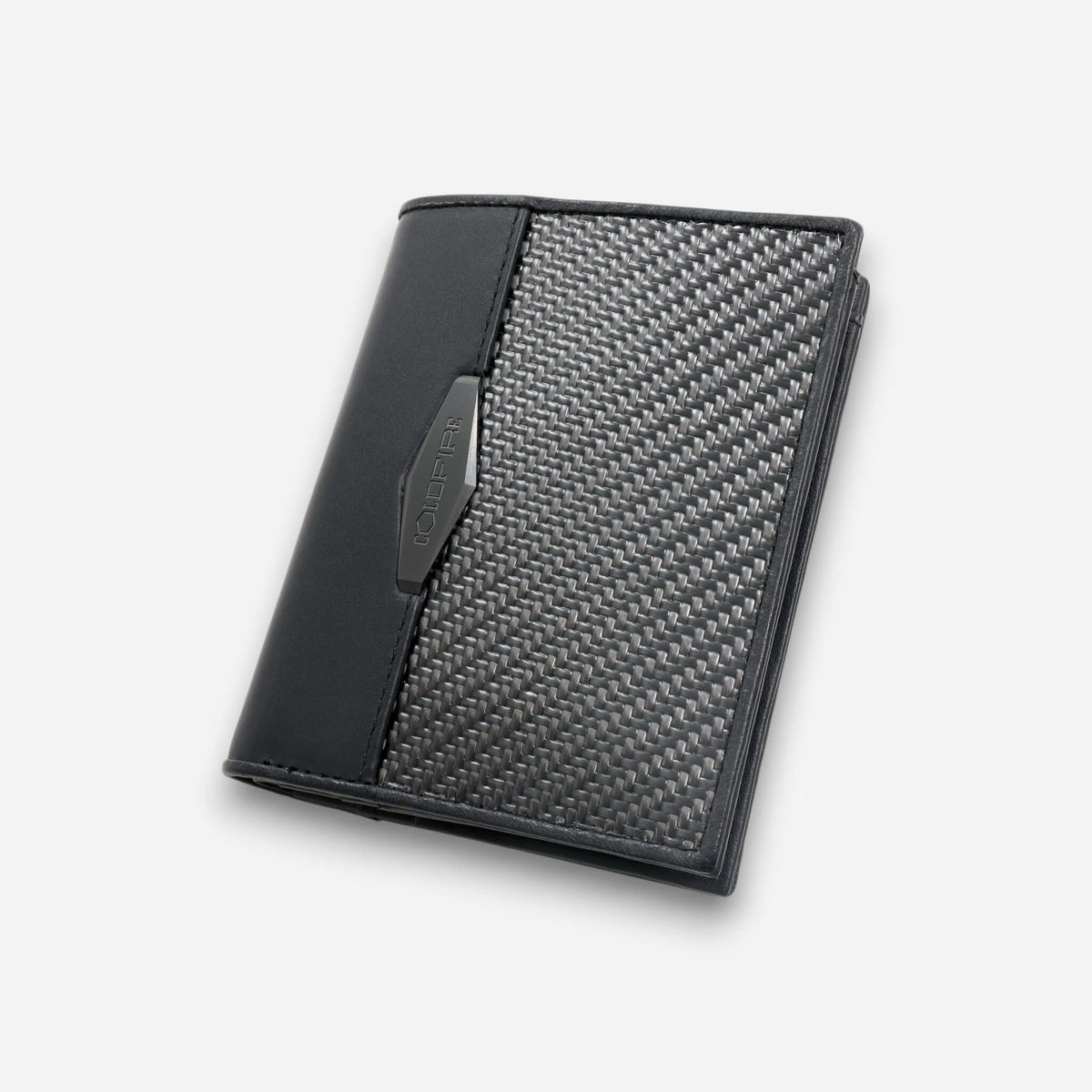
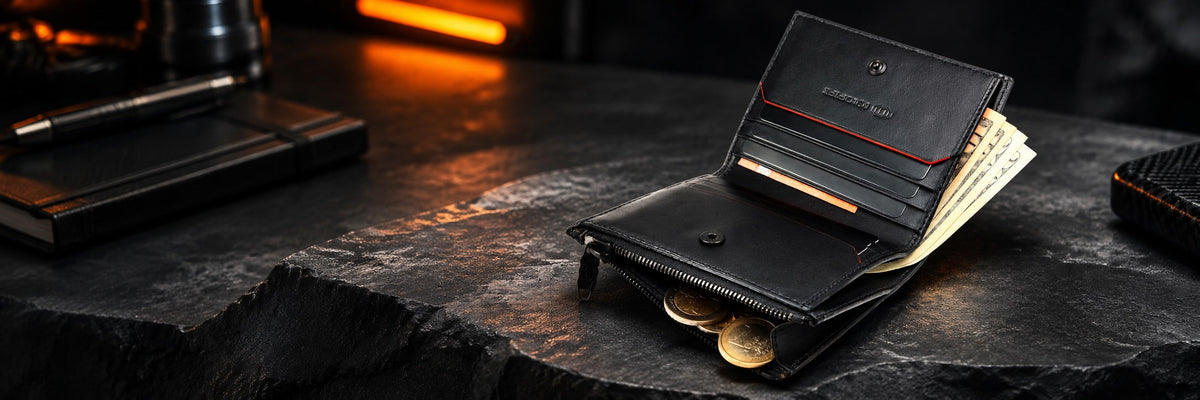
A vertical bifold is a bifold turned ninety degrees. Instead of folding left to right across a wide body, it folds top to bottom across a tall, narrow one, usually about 85 mm wide and 100 to 105 mm tall closed. The card slots run horizontally across the inside faces, and a bill compartment runs across the top, so a euro note lies flat and a dollar note folds once. It is, as far as we know, the only wallet format designed around the front pocket rather than adapted to it, and it exists for a simple reason: a vertical bifold closed is the size and shape of a stack of cards, which is what a front pocket was already holding.
The format has two advantages over a cardholder and one over a horizontal slim bifold. Against a cardholder, it folds, so it carries cash properly and it protects the card faces on the inside. Against a horizontal slim bifold of the same capacity, it is narrower, so it drops into the pocket instead of lying across it, and the fold sits at the bottom where the pocket is deepest rather than against your hip bone. Its one cost is that it is slightly taller, which only matters in a very shallow pocket.
Our Flex series is this format. The Flex One is the standard vertical bifold: four card slots, two slip pockets, an outside quick-access slot and a bill pocket, at 46 grams and 5.5 mm closed. The Flex Ultra is the full-capacity version: five slots, an ID window, the outside slot, two slip pockets and a full bill compartment at 58 grams and 8 mm closed. Both are built on a flexible carbon fiber shell with a kangaroo leather interior, which is why they stay at those thicknesses loaded; the shell does not stretch and the leather does not swell. The Flex Air is the cardholder in the same family: three cards and an ID window at 42 grams and 5 mm, for people who have given up cash.

Front pocket wallet formats compared
| Format | Typical size | Cards | Cash | Best for | Weak point |
|---|---|---|---|---|---|
| Card sleeve | 65 x 100 mm, 4 to 6 mm, 20 to 30 g | 2 to 5 | A folded note behind the cards | Cards only, shirt or coin pocket | Stretches in soft leather; no card separation |
| Cardholder | 75 x 105 mm, 5 to 7 mm, 30 to 45 g | 3 to 6 | A folded note in the centre pocket | Cards and the occasional note | Cash is an afterthought |
| Vertical bifold | 85 x 102 mm, 5 to 9 mm, 45 to 60 g | 4 to 6 | Proper bill compartment | Cards and cash in a front pocket | Slightly taller than a cardholder |
| Horizontal slim bifold | 110 x 85 mm, 8 to 12 mm, 50 to 80 g | 6 to 8 | Full bill compartment | Back pocket or jacket; front pocket only in loose trousers | Too wide for most front pockets |
| Plate or aluminium wallet | 86 x 54 mm, 6 to 12 mm, 60 to 90 g | 1 to 12 under a band | Outside clip or strap | Hard shell, cards only | Does not fold; band and screws are wear parts; heavy |
| Money clip | Varies | 2 to 4 under the clip | Yes, exposed | Cash-first carry | Cards unprotected; everything visible |
Leather front pocket wallets: what to look for
A leather front pocket wallet lives or dies on the leather, because a thin wallet has no bulk to hide stretch behind. Three rules. First, full-grain or kangaroo, never "genuine leather", which is split hide with a coating and the fastest-stretching material sold as leather. Second, thin leather that is strong, not thick leather that is bulky; this is the reason kangaroo hide exists in wallets at all, since it keeps its strength when split to under a millimetre where cowhide does not. Third, slot construction. A slot that is a single layer of leather stitched to the body will loosen; a slot with a reinforced or lined edge holds. Horizontal leather cardholders from the better makers get this right, which is why well-made leather pieces such as Bellroy's and Secrid's tend to hold their shape in a front pocket better than cheaper ones. Lining matters too, and we compared the options in wallet linings compared.
The honest limitation of any all-leather front pocket wallet is that leather is the structure. Nothing else holds the shape, so the thinner and softer the leather, the faster the wallet grows. That is the problem the Flex series was built to solve: the leather does the work leather is good at, which is the hand feel and the slots, and a flexible carbon fiber shell does the structural work. The comparison is in how long does a wallet last.
Best front pocket wallets of 2026, by type
Best vertical bifold: COLDFIRE Flex One
The format's reference point. 85 x 102 mm, 5.5 mm closed and about 9 mm loaded, 46 grams, four card slots, two slip pockets, an outside slot for the card you tap and a bill pocket that takes a euro note flat. Flexible carbon fiber shell (Carbitex CX6), kangaroo leather interior, titanium logo plate, RFID shielding in the slots and the body, and a five-year structural guarantee against stretching or losing shape. It was one of ten wallets in Gear43's 2026 bifold wallet awards, named Best Unique Bifold by a channel that keeps more than 150 wallets on hand, and the one criticism in that review, that the matte carbon does not look "finished" to someone expecting glossy epoxy, is addressed in flexible vs traditional carbon fiber.
Best full-capacity front pocket wallet: COLDFIRE Flex Ultra
For the man who refuses to carry less. Same footprint as the Flex One, 8 mm closed and 9 to 13 mm loaded, 58 grams, five card slots, an ID window, the outside slot, two slip pockets and a full bill compartment. It is the most carry we make in a wallet that still drops into a front pocket, and because the shell is carbon it does not stretch, so how thick it gets depends on what you put in it, not on the wallet giving way.
Best front pocket cardholder: COLDFIRE Flex Air
82 x 103 mm, 5 mm closed and 7 to 8 mm loaded, 42 grams, two card slots, two slip pockets and an ID window, so three cards with the ID visible. For cards-only carry it is the lightest way to get the same shell and leather as the bifolds.
Best card sleeve: COLDFIRE Scout One
25 grams and 5 mm, four to five cards in a flexible carbon fiber spine with a kangaroo leather interior and RFID shielding. The Scout One is for the coin pocket or the shirt pocket as much as the front pocket, and it is the smallest thing we make.
Best leather front pocket wallet from another maker: Bellroy Slim Sleeve
A horizontal leather cardholder with a pull-tab pocket for the cards you use less, in leather. It carries a couple of folded notes behind the cards. It is leather-only, so expect the slots to ease over years, but it is the best-made example of the format at its price.
Best plate wallet: The Ridge
If you want a hard aluminium or titanium shell around your cards, this is the one that defined the category. It is a case, not a wallet: cards are held by an elastic band or a money clip on the outside, and it does not fold. We compared it against flexible carbon and leather in Best Ridge Wallet Alternatives.
All three Flex wallets and the Scout One are in the slim wallets collection. Every material is named with its maker on the Engineering and Quality page.
How to carry a wallet in your front pocket
It sounds obvious, and most people get it slightly wrong for the first week. Put the wallet in the pocket opposite your phone, so the two never grind against each other and so that a hand reaching for one does not find the other. Put a vertical bifold in fold down, so the closed spine takes the pressure when you sit and the slots face up inside the wallet where its own fold keeps them shut. Keep keys in a different pocket or on a clip; keys are what scratch a wallet face, not use. If you drive a lot, the front pocket on your non-driving side is the one that does not get crushed against the seat belt buckle. Finally, do the card audit before you move, not after: a front pocket wallet full of loyalty cards is a back pocket wallet in the wrong place. Our list of what belongs in a wallet is in What to Keep in Your Wallet.
Four mistakes front pocket converts make
- Moving the old bifold forward. A 115 mm wide wallet across the top of the thigh is less comfortable than it was in the back. Buy the format for the pocket.
- Choosing by empty thickness. 6 mm empty and 14 mm loaded is a 14 mm wallet. Ask for, or measure, the loaded figure.
- Buying soft leather because it feels nice in the shop. Softness in a thin wallet is early stretch. Full-grain, kangaroo or a composite shell.
- Keeping cash outside the wallet. A clip on the back of a plate wallet is banknotes against your phone. If you carry cash weekly, buy a format that folds.
Front pocket wallet questions, answered
What is a front pocket wallet?
A wallet sized and shaped to be carried in a trouser front pocket rather than sat on in a back pocket: typically under 90 mm wide, under 105 mm tall, under 10 mm thick loaded and under 60 grams, in a vertical format such as a cardholder, a card sleeve or a vertical bifold.
Is it better to carry a wallet in the front pocket?
For most people, yes. It is harder to pickpocket, it is never sat on, so it does not curve or split, and it avoids the pelvic tilt a thick back pocket wallet causes when sitting. The condition is that the wallet has to be built for the pocket; a standard bifold moved forward is worse in both places.
What is a vertical bifold wallet?
A bifold that folds top to bottom instead of side to side, making it narrow and tall (about 85 by 102 mm) so it drops into a front pocket. It carries four to six cards in horizontal slots and bills in a compartment across the top. The COLDFIRE Flex One and Flex Ultra are vertical bifolds.
How thick should a front pocket wallet be?
Under about 10 mm with your cards in it. Measure loaded, because soft leather wallets can double in thickness in a year, and a wallet that is already 10 mm empty is too thick for comfort when you sit.
What is the best front pocket wallet for men?
For cards and cash, a vertical bifold such as the COLDFIRE Flex One (46 g, 5.5 mm, four cards and bills). For cards only, a cardholder such as the Flex Air or a leather piece such as the Bellroy Slim Sleeve. For a hard shell, the Ridge. Whichever you choose, pick a material that does not stretch.
Can a front pocket wallet hold cash?
Yes, if it is a vertical bifold. Cardholders and sleeves take a folded note or two; plate wallets hold cash under an outside strap. A vertical bifold has a real bill compartment, which is the reason the format exists.
Written by Todor Georgiev, founder of COLDFIRE and a leather goods manufacturer in Plovdiv since 2000. COLDFIRE dimensions and weights are workshop measurements; the Bellroy Slim Sleeve and the Ridge are described from their published specifications. COLDFIRE has no commercial relationship with either maker. Gear43 is a COLDFIRE affiliate partner.

Condividi:
Real vs Fake Carbon Fiber: How to Tell, What Forged Carbon Is, and What a Carbon Fiber Wallet Usually Means
Belt Rules: Suit, Tuxedo, Suspenders, Matching Your Shoes, and How to Wear One Properly