
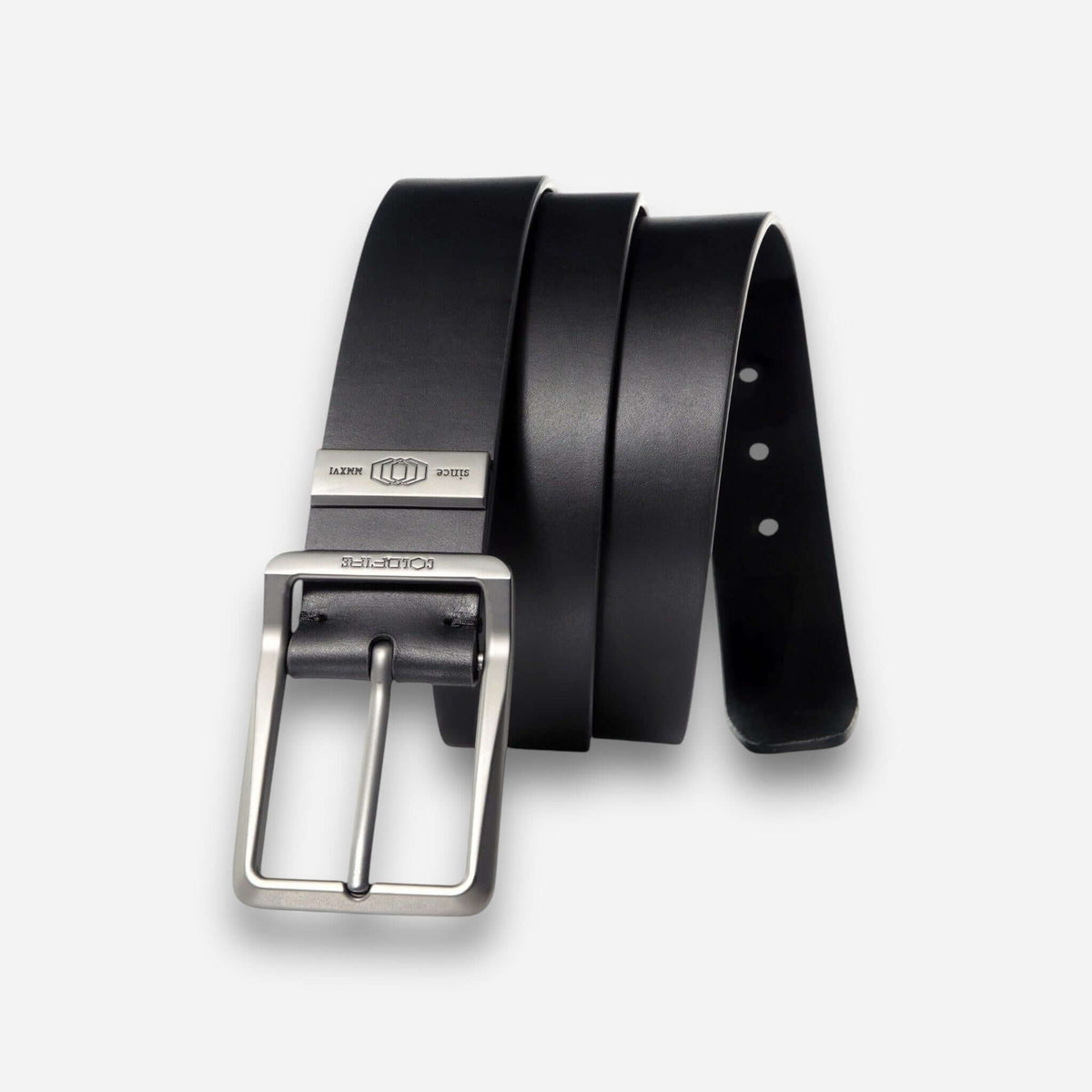
Most belt rules come down to one idea: the belt is there to finish the outfit, not to be noticed in it. Once you know that, the individual questions answer themselves. Do you wear a belt with a suit? Usually, and a quiet one. With a tuxedo? Never. With suspenders? Never both at once. Should the belt match the shoes? When the clothes are formal, yes; when they are not, the rule relaxes. This guide sets out each rule with the reason behind it, so you can break the ones that do not apply to you, and it covers the mechanics nobody explains: which way a belt goes, how long the tail should be, which hole to use, and what to do about buckle metal. For choosing the belt itself, our guide to men's leather belts covers leather grades and construction; for sizing, the belt size chart.

The short version
| Situation | Belt? | Which one |
|---|---|---|
| Suit with belt loops | Yes | 30 to 38 mm, leather matched to the shoes, matte or lightly polished buckle in the metal of your watch |
| Suit with side adjusters | No | The adjusters do the job; a belt has no loops to go through |
| Suit with a waistcoat | Optional, better without | If the trousers have loops, a slim belt that disappears under the waistcoat |
| Tuxedo or dinner suit | No | Braces or side adjusters, with a cummerbund or waistcoat covering the waist |
| Suspenders or braces | No | Never with a belt. One holds the trousers up; the other would be decoration |
| Chinos, smart casual | Yes | 35 to 38 mm, brown or cognac, shoes in the same family |
| Jeans | Yes, if there are loops | 35 to 40 mm, any leather, buckle with some presence allowed |
| Shorts | Optional | A light casual belt, or none; nothing formal |
| Untucked shirt | Yes, if the trousers have loops | Loops without a belt look unfinished even when covered |
Do you wear a belt with a suit?
If the trousers have belt loops, yes. Empty loops are the one thing that reads as careless from across a room. The belt should be the least interesting thing you are wearing: 30 to 38 mm wide, in a leather that matches the shoes in colour and roughly in finish, with a plain pin buckle in a metal that matches your watch or cufflinks. Thirty-eight millimetres is the upper limit for a suit and works with the standard loops on most modern trousers; if the suit is slim-cut with narrow loops, go to 30 or 35 mm. Anything wider, any decorative buckle, and any woven or canvas belt moves the outfit out of business dress.
If the trousers have side adjusters, the small buckled or buttoned tabs at the hips, they were cut to be worn without a belt and usually have no loops. Do not add belt loops to them. If the suit comes with a waistcoat, the waistcoat is meant to cover the waistband, so a belt buckle under it is a lump; wear side adjusters or braces, or a very slim belt if the trousers insist on loops. The classic three-piece suit is worn beltless for this reason.
Do you wear a belt with a tuxedo?
No. Tuxedo trousers are made without belt loops, and a belt is the one accessory that has no place in black tie. The waist is held by braces (suspenders) or by side adjusters, and it is covered by a cummerbund or a low-cut evening waistcoat, so that the line from shirt to trouser is unbroken. If a rental tuxedo arrives with belt loops, that is the rental company saving money on a pattern, not a change in the rule; wear braces and leave the loops empty under the cummerbund. The same applies to a dinner suit, a white dinner jacket and any outfit described as black tie or black tie optional.
Do you wear a belt with suspenders?
No, never both. Suspenders and a belt do the same job, holding the trousers at the waist, and wearing both says you trust neither. Braces are the more formal option and the more comfortable one for long days, because the trousers hang from the shoulders instead of gripping the waist. If you choose braces, the trousers should have buttons inside the waistband for them; clip-on braces over belt loops are a compromise that reads as one. If you choose a belt, take the braces off. The one exception people cite, the workwear look with suspenders over a belted jean, is a costume, not a rule.
How to wear a belt: the mechanics
Which way does a belt go?
For men, the convention is that the tail points to your left. Thread the belt into the loop at your left hip first, take it around your back, and bring it through the buckle at the front so the tip crosses to the left. Women traditionally wear it the other way, tail to the right, which is why belts with a directional emboss or a printed inside are cut for one or the other. It is a convention rather than a law, but a belt threaded the "wrong" way is noticed by anyone who sells or makes them, and a left-handed man is allowed to ignore it.
How long should the tail be?
After the buckle, the tip should pass through the first loop on the trousers and the keeper on the belt, and end somewhere between the first and second belt loop: roughly 8 to 15 cm, three to six inches, past the buckle. Shorter than that and the tip pops out of the keeper every time you sit. Longer, and you have bought the wrong size. The size chart explains how to get that right: a belt two inches larger than your waist measurement puts you on the middle hole with the correct tail.
Which hole should you use?
The middle one. A belt is cut with five holes, sometimes seven, so that the centre hole is the fit and the holes either side absorb a heavy lunch or a loose waistband. A belt worn on the first hole is too small and will stretch at the fold within months; a belt on the last hole has a tail that wraps halfway round you. If your belt sits on the first or last hole, change the belt, not the hole. If a good belt has become slightly loose over years, a leatherworker can add a hole cleanly; our belt care and repair guide covers how to punch a hole without ruining the strap.
Should the buckle match anything?
Yes, the other metal you are wearing. Silver-toned buckle with a steel watch and silver cufflinks; gold with gold; gunmetal or black with a black watch case or no other metal at all. A matte finish is the safe choice because it sits with any of them without competing, which is why COLDFIRE belts use matte gunmetal hardware. Matching metals is the detail that separates a put-together outfit from a correct one.
Should your belt match your shoes?
In formal and business dress, yes: black belt with black shoes, brown with brown, in roughly the same shade and finish. A polished black oxford wants a smooth black belt, not a matte pebbled one. The rule exists because the belt and shoes are the only two leather items in a suit outfit, and when they match they disappear; when they differ, the eye travels between them.
Outside formal dress the rule loosens in proportion to how casual the clothes are. With chinos and loafers, a belt in the same colour family as the shoes is enough: dark oak with chestnut, cognac with tan. With jeans and boots, matching matters very little and contrast can look deliberate. With sneakers, the shoes are not leather and the rule does not apply; choose the belt for the trousers instead.
Can you wear a brown belt with black pants?
With black dress trousers and black shoes, no; the brown belt is the one thing in the outfit that is not black, and it looks like a mistake. With black jeans or black chinos and brown boots or shoes, yes, and it is a classic smart casual pairing; the belt follows the shoes. The question is really about the shoes, not the trousers.
Can you wear a black belt with brown shoes?
Same logic. In a suit, no. In casual wear with dark brown or burgundy shoes, it passes, though dark brown would be better. Of the two mismatches, a black belt with brown shoes is the more forgiving, because black reads as neutral in casual clothes.
Width, colour and formality in one place
Three levers set how formal a belt is, and they move together. Narrower is more formal, so dress belts run 30 to 35 mm and casual belts 38 to 40 mm. Smoother and darker is more formal, so a smooth black belt is the most formal and a pebbled or embossed cognac the least. Smaller and plainer buckles are more formal, so a slim pin buckle in a matte metal goes with a suit and a heavy or decorated buckle does not. A 38 mm belt in smooth black or dark brown with a plain matte buckle sits at the point where it still passes with a suit and is not too fine for denim, which is why most men who own one belt own that one. Our thoughts on choosing by colour are in the colour section of the belt buying guide.
- Suit, business
- 30 to 38 mm, smooth black or dark brown matched to the shoes, matte or lightly polished pin buckle in the metal of your watch. Titan Black or Titan Dark Oak.
- Smart casual
- 35 to 38 mm, dark brown or cognac, shoes in the same family. Titan Dark Oak or Titan Cognac.
- Evening, not black tie
- 38 mm black with texture is allowed: an embossed belt reads as dressed up with dark trousers and a jacket. Titan Elite Pyramid or Snake.
- Denim
- 35 to 40 mm, any colour, buckle with presence allowed. Any Titan.
- Black tie
- No belt. Braces and a cummerbund or waistcoat.
Every COLDFIRE belt is 38 mm, cut from Italian full-grain hide with a matte gunmetal pin buckle, in nine sizes from 32 to 48 inches: the Titan Grip series. Check the size chart first so you land on the middle hole.
Five belt mistakes that are noticed
- Empty belt loops with a suit. The single most visible one. Wear a belt or wear trousers without loops.
- A belt with a tuxedo, or with suspenders. Both say the rules were not known. Neither is forgiven in black tie.
- A buckle that fights the watch. Gold buckle, steel watch. Pick one metal or go matte.
- The first or last hole. Either the belt is the wrong size or it has stretched. Fix the size.
- A belt bought to match one pair of shoes. Buy black and dark brown and you are dressed for everything except black tie.
Belt rules, answered
Do you wear a belt with a suit?
Yes, if the trousers have belt loops: a 30 to 38 mm leather belt matched to the shoes, with a plain buckle in the metal of your watch. If the trousers have side adjusters or you are wearing a waistcoat, no belt is needed and the outfit is cleaner without one.
Do you wear a belt with a tuxedo?
No. Tuxedo trousers have no belt loops; the waist is held by braces or side adjusters and covered by a cummerbund or evening waistcoat. A belt has no place in black tie, even if a rental pair of trousers arrives with loops.
Do you wear a belt with suspenders?
No. Suspenders and a belt do the same job, and wearing both looks like you trust neither. Choose one. Braces are the more formal and the more comfortable option for a long day; a belt is the everyday one.
Should your belt match your shoes?
In formal and business dress, yes, in colour and roughly in finish. In smart casual, the same colour family is enough. With jeans and boots, matching matters little, and with sneakers the rule does not apply at all.
Can you wear a brown belt with black pants?
Not with black dress trousers and black shoes. With black jeans or chinos and brown shoes or boots, yes; the belt follows the shoes, not the trousers.
Which way does a man's belt go?
Tail to the left. Thread it into the loop at your left hip, around the back, and through the buckle so the tip crosses to your left. Women traditionally wear the tail to the right.
How long should the end of a belt be?
Through the first trouser loop and the belt keeper, ending roughly 8 to 15 cm (three to six inches) past the buckle, on the middle hole. If it is shorter or much longer, the belt is the wrong size.
Written by Todor Georgiev, founder of COLDFIRE and a leather goods manufacturer in Plovdiv since 2000. Published 3 November 2026. The conventions described are the ones used in classic menswear tailoring; where a rule is a matter of taste rather than tailoring, the article says so.

Partager:
Front Pocket Wallets: Why Men Are Switching, What Actually Fits, and the Best of 2026
Money Clip or Bill Pocket? Wallets With a Money Clip, Wallets With a Coin Pocket, and What Actually Works